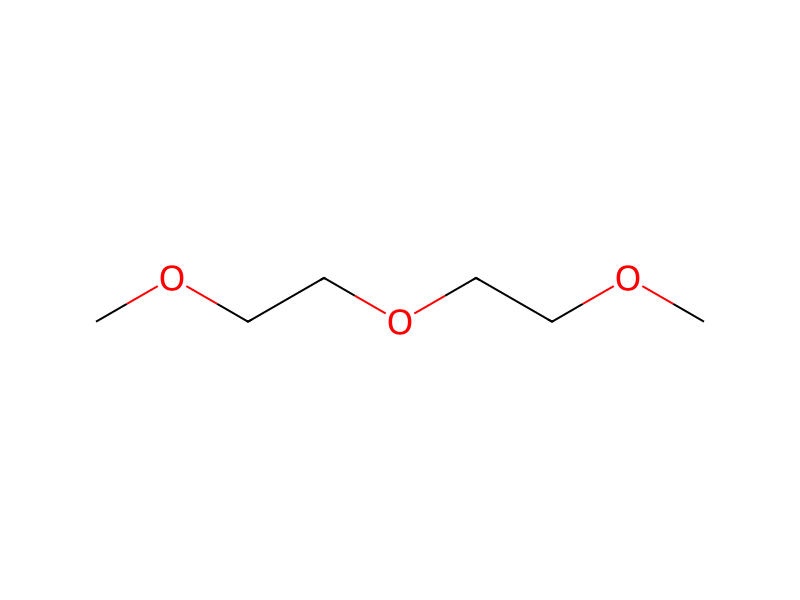
Diglyme → HCID 131726624, compound
Reaction equation

[CH2:1]=[C:2]([C:10]([O:13]S(F)(=O)=O)([F:12])[F:11])[C:3]([C:6]([F:9])([F:8])[F:7])([F:5])[F:4].[F-:18].[K+].[F:20][C:21]([F:29])([F:28])[C:22]([C:24]([F:27])([F:26])[F:25])=O.COCCOCCOC>O>[CH2:1]=[C:2]([C:10]([O:13][C:22]([C:24]([F:27])([F:26])[F:25])([C:21]([F:29])([F:28])[F:20])[F:18])([F:12])[F:11])[C:3]([C:6]([F:9])([F:8])[F:7])([F:5])[F:4]Participants
Reactant 4



Product 1

Reagents, catalysts & solvents 1

Conditions
- Temperature
- 20 °C
Procedure
CH2═C(CF2CF3)CF2OSO2F (5 g, 17 mmole) is added at 20° C. to (CF3)2CCFOK, prepared at 10° C. from freshly dried KF (3 g, 17.2 mmole), hexafluoroacetone (HFA) (3 g, 18 mmole) and dry diglyme (15 ml). The reaction mixture is agitated for 1 hour at 20° C. and then poured into water, the organic layer separating. The organic layer is washed with aqueous sodium bicarbonate solution, then water, after which it is dried over (MgSO4). Distillation of the reaction mixture gives CH2═C(CF2CF3)CF2OCF(CF3)2 (4 g, 62% yield, b.pt. 118–120° C.). This example demonstrates that the fluorosulfates of the higher homolog of hexafluoroisobutylene react with nucleophiles under the same mild conditions that characterize the reactions of CH2═C(CF3)CF2OSO2F.
Workup
- customthe organic layer separating
- washThe organic layer is washed with aqueous sodium bicarbonate solution
- dry with materialwater, after which it is dried over (MgSO4)
- distillationDistillation of the reaction mixture
Sources & evidence
- ORD record
- ord-de38acd374ef4c14bd219655f467fc6d
- Source dataset
- uspto-grants-2007_10
- Patent number
- US07276624B2
Reaction notes
Loading…