Isobutylene oxide → 5-Bromo-1-(2-hydroxy-2-methylpropyl)-2(1H)-pyridinone
Reaction equation

[Br:1][C:2]1[CH:3]=[CH:4][C:5](=[O:8])[NH:6][CH:7]=1.[CH3:9][C:10]1([CH3:13])[CH2:12][O:11]1.C([O-])([O-])=O.[K+].[K+]>CN(C=O)C.C(OCC)(=O)C>[Br:1][C:2]1[CH:3]=[CH:4][C:5](=[O:8])[N:6]([CH2:9][C:10]([OH:11])([CH3:13])[CH3:12])[CH:7]=1Participants
6


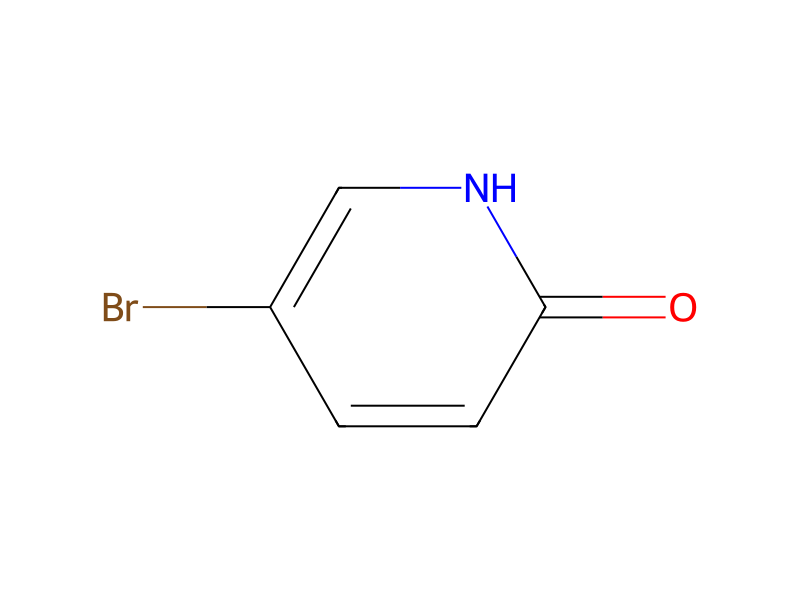



Conditions
- Temperature
- 100 °C
Procedure
A mixture of 5-bromopyridin-2(1H)-one (600 mg, 3.5 mmol), 2,2-dimethyloxirane (750 mg, 10.4 mmol) and K2CO3 (960 mg, 6.9 mmol) in DMF (3 mL) was heated at 100° C. for 2 hours. The reaction mixture was allowed to cool to room temperature. The reaction mixture was diluted with ethyl acetate (80 mL), washed with water, brine, and dried over MgSO4. The organic layer was filtered and concentrated under reduced pressure. The residue was purified by silica gel chromatography (eluting with 10 to 50% EtOAc/hexane) to give Compound 244a (650 mg, 76% yield). 1H NMR (400 MHz, CDCl3) δ 7.50 (d, J=2.6 Hz, 1H), 7.40 (dd, J=9.6, 2.8 Hz, 1H), 6.54 (d, J=9.7 Hz, 1H), 3.99 (s, 2H), 3.57-3.39 (s, 1H), 1.27 (s, 6H).
Workup
- temperatureto cool to room temperature
- washwashed with water, brine
- dry with materialdried over MgSO4
- filtrationThe organic layer was filtered
- concentrationconcentrated under reduced pressure
- customThe residue was purified by silica gel chromatography (eluting with 10 to 50% EtOAc/hexane)
Sources & evidence
- ORD record
- ord-641891c684054ed89ae5d936144c7f6c
- Source dataset
- uspto-grants-2014_03
- Patent number
- US08680090B2
Reaction notes
Loading…