Hydrochloric Acid → 5-Bromo-2-ethylbenzaldehyde
Reaction equation

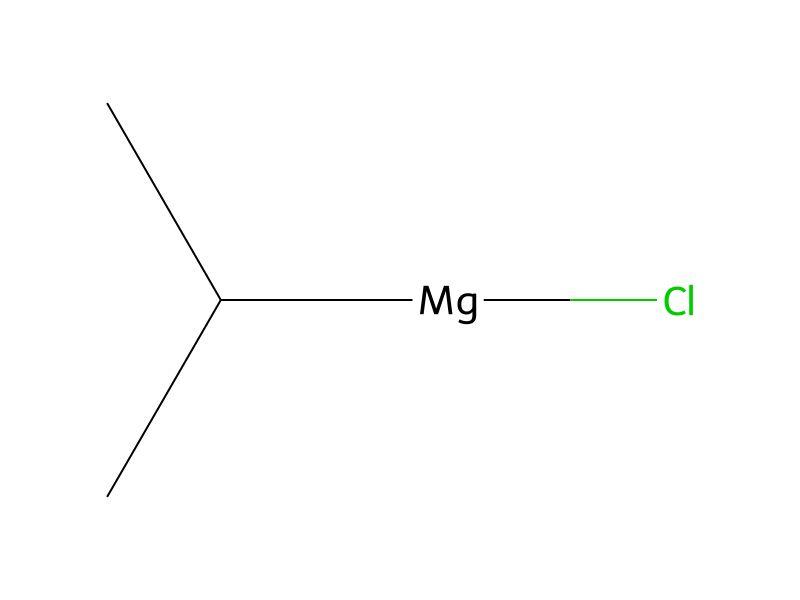
[Br:1][C:2]1[CH:7]=[CH:6][C:5]([CH2:8][CH3:9])=[C:4](I)[CH:3]=1.C([Mg]Cl)(C)C.CN(C)[CH:18]=[O:19].Cl>O1CCCC1>[Br:1][C:2]1[CH:7]=[CH:6][C:5]([CH2:8][CH3:9])=[C:4]([CH:3]=1)[CH:18]=[O:19]Participants





Conditions
- Temperature
- -20 °C
Procedure
To a solution of 4-bromo-1-ethyl-2-iodobenzene (31.8 g, 103 mmol) (described in WO 2008/071405) in anhydrous tetrahydrofuran (250 ml) at −20° C. is added isopropyl magnesium chloride (55 ml, 110 mmol, 2M solution in tetrahydrofuran) dropwise over 10 minutes. Once the addition is complete the reaction mixture is stirred at −20° C. for 3 hours, followed by dropwise addition of anhydrous N,N-dimethylformamide (16.0 ml, 200 mmol). The reaction mixture is stirred at room temperature for a further 2.5 hours, then left to stand overnight. 2M hydrochloric acid (90 ml) is added and the crude product is extracted into dichloromethane. Organics are combined, dried over magnesium sulfate then filtered and the filtrate evaporated under reduced pressure to afford 5-bromo-2-ethyl-benzaldehyde (21.20 g) as an orange liquid.
Workup
- additionOnce the addition
- stirringThe reaction mixture is stirred at room temperature for a further 2.5 hours
- waitleft
- waitto stand overnight
- extractionthe crude product is extracted into dichloromethane
- dry with materialdried over magnesium sulfate
- filtrationthen filtered
- customthe filtrate evaporated under reduced pressure
Sources & evidence
- ORD record
- ord-b651163f003a41b981c10a2f3d9ae0e2
- Source dataset
- uspto-grants-2014_03
- Patent number
- US08680299B2
Reaction notes
Loading…