Diisopropylamine → 4,4-Dimethyl-6-ethynylchroman
Reaction equation

C(NC(C)C)(C)C.C([Li])CCC.[CH3:13][C:14]1([CH3:27])[C:23]2[C:18](=[CH:19][CH:20]=[C:21]([C:24](=O)[CH3:25])[CH:22]=2)[O:17][CH2:16][CH2:15]1.P(Cl)(OCC)(OCC)=O.C([N-]C(C)C)(C)C.[Li+]>O1CCCC1.CCCCCC>[CH3:13][C:14]1([CH3:27])[C:23]2[C:18](=[CH:19][CH:20]=[C:21]([C:24]#[CH:25])[CH:22]=2)[O:17][CH2:16][CH2:15]1Participants
Reactant 5



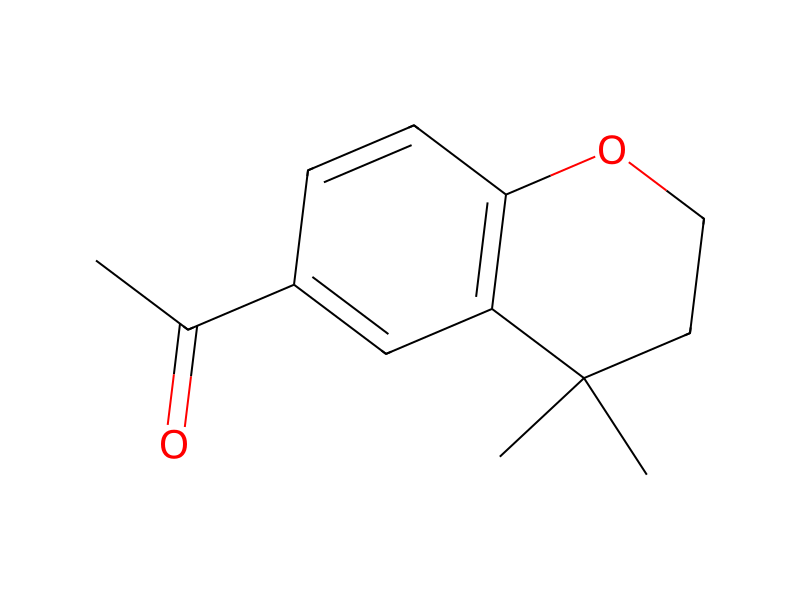

Product 1

Reagents, catalysts & solvents 2


Conditions
- Temperature
- -78 °C
Procedure
To a solution of 2.47 g (24.41 mmol) of diisopropylamine in 40 ml dry tetrahydrofuran under argon at -78° C. was added dropwise 15.2 ml of 1.6M (24.32 mmol) n-butyl lithium in hexane. This mixture was stirred at -78° C. for 1 hour and then treated dropwise with a solution of 4.98 g (24.38 mmol) of 4,4-dimethyl-6-acetylchroman (from Example 9) in 4 ml dry of tetrahydrofuran. After stirring at -78° C. for 1 hour, the solution was treated with 4.2 g (24.36 mmol) of diethyl chlorophosphate. The cooling bath was then removed and the reaction mixture stirred at room temperature for 2.75 hours. This solution was then transferred using a double ended needle to a solution of lithium diisopropyl amide [prepared using 4.95 g (48.92 mmol) of diisopropylamine and 30.5 ml of 1.6M (48.8 mmol) n-butyllithium in hexane] in 80 ml dry tetrahydrofuran at -78° C. The cooling bath was removed and mixture stirred at room temperature for 18 hours and then quenched with 50 ml water and 25 ml of 3N hydrogen chloride. The mixture was extracted with 2×100 ml and 3×50 ml of pentane and the combined organic fractions washed with 3N hydrogen chloride, water, saturated NaHCO3 and saturated NaCl solutions and then dried (MgSO4). Solvent was then removed in vacuo and the residue purified by flash chromatography (silica; 10% ethyl acetate in hexane) followed by kugelrohr distillation (70° C.; 0.35 mm) to give the title compound as a colorless crystalline solid. PMR (CDCl3): δ 1.33 (6H), 1.81-1.86 (2H, m), 3.00 (1H, s), 4.19-4.24 (2H, m), 6.75 (1H, d, J~8.5 Hz), 7.22 (1H, dd, J~8.5 Hz, 2.3 Hz), 7.44 (1H, d, J~2.3 Hz).
Workup
- dry with materialdry of tetrahydrofuran
- stirringAfter stirring at -78° C. for 1 hour
- customThe cooling bath was then removed
- stirringthe reaction mixture stirred at room temperature for 2.75 hours
- customat -78° C
- customThe cooling bath was removed
- stirringmixture stirred at room temperature for 18 hours
- customquenched with 50 ml water and 25 ml of 3N hydrogen chloride
- extractionThe mixture was extracted with 2×100 ml and 3×50 ml of pentane
- washthe combined organic fractions washed with 3N hydrogen chloride, water, saturated NaHCO3 and saturated NaCl solutions
- dry with materialdried (MgSO4)
- customSolvent was then removed in vacuo
- customthe residue purified by flash chromatography (silica; 10% ethyl acetate in hexane)
- distillationfollowed by kugelrohr distillation (70° C.; 0.35 mm)
Sources & evidence
- ORD record
- ord-f6543c04560745bea6d31afa6c8a2cc1
- Source dataset
- uspto-grants-1989_03
- Patent number
- US04810804
Reaction notes
Loading…