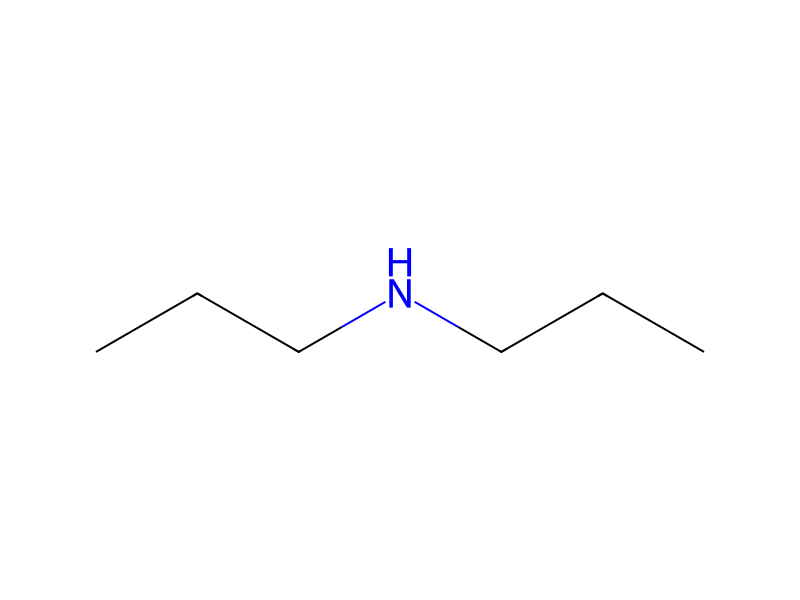
Dipropylamine → HCID 19898813, compound
Reaction equation

[C:1]1([C:7]2[C:15]([CH2:16][C:17]([OH:19])=O)=[C:10]3[N:11]=[CH:12][CH:13]=[CH:14][N:9]3[N:8]=2)[CH:6]=[CH:5][CH:4]=[CH:3][CH:2]=1.C(N1C=CN=C1)(N1C=CN=C1)=O.[CH2:32]([NH:35][CH2:36][CH2:37][CH3:38])[CH2:33][CH3:34]>O1CCCC1>[C:1]1([C:7]2[C:15]([CH2:16][C:17]([N:35]([CH2:36][CH2:37][CH3:38])[CH2:32][CH2:33][CH3:34])=[O:19])=[C:10]3[N:11]=[CH:12][CH:13]=[CH:14][N:9]3[N:8]=2)[CH:2]=[CH:3][CH:4]=[CH:5][CH:6]=1Participants
5
Reactant 3


Product 1

Reagents, catalysts & solvents 1

Procedure
A mixture of 3.5 g (0.013 mole) of 2-phenylpyrazolo[1,5-a]pyrimidine-3-acetic acid and 2.24 g (0.013 mole) of 1,1'-carbonyldiimidazole in 150 ml of anhydrous tetrahydrofuran was stirred for 4 hours at room temperature while nitrogen was bubbled through the mixture. After additional stirring, a solution of 4.19 g (0.041 mole) of di-n-propylamine in 10 ml of anhydrous tetrahydrofuran was added dropwise and the mixture was stirred for about 17 hours under a nitrogen atmosphere. The solvent was evaporated under reduced pressure and the residue (7.3 g) was recrystallized from ethanol-water to give 3.3 g of product (72%), mp 103°-105° C.
Workup
- customwas bubbled through the mixture
- stirringthe mixture was stirred for about 17 hours under a nitrogen atmosphere
- customThe solvent was evaporated under reduced pressure
- customthe residue (7.3 g) was recrystallized from ethanol-water
Sources & evidence
- ORD record
- ord-2e29afcc11c24812b03774afd55096c4
- Source dataset
- uspto-grants-1992_05
- Patent number
- US05114944
Reaction notes
Loading…