Tryptamine → HCID 3725933, compound
Reaction equation

[NH2:1][CH2:2][CH2:3][C:4]1[C:12]2[C:7](=[CH:8][CH:9]=[CH:10][CH:11]=2)[NH:6][CH:5]=1.C(N(CC)CC)C.[C:20](Cl)([C:33]1[CH:38]=[CH:37][CH:36]=[CH:35][CH:34]=1)([C:27]1[CH:32]=[CH:31][CH:30]=[CH:29][CH:28]=1)[C:21]1[CH:26]=[CH:25][CH:24]=[CH:23][CH:22]=1>C(Cl)Cl>[C:20]([NH:1][CH2:2][CH2:3][C:4]1[C:12]2[C:7](=[CH:8][CH:9]=[CH:10][CH:11]=2)[NH:6][CH:5]=1)([C:21]1[CH:26]=[CH:25][CH:24]=[CH:23][CH:22]=1)([C:33]1[CH:34]=[CH:35][CH:36]=[CH:37][CH:38]=1)[C:27]1[CH:28]=[CH:29][CH:30]=[CH:31][CH:32]=1Participants
5
Reactant 3
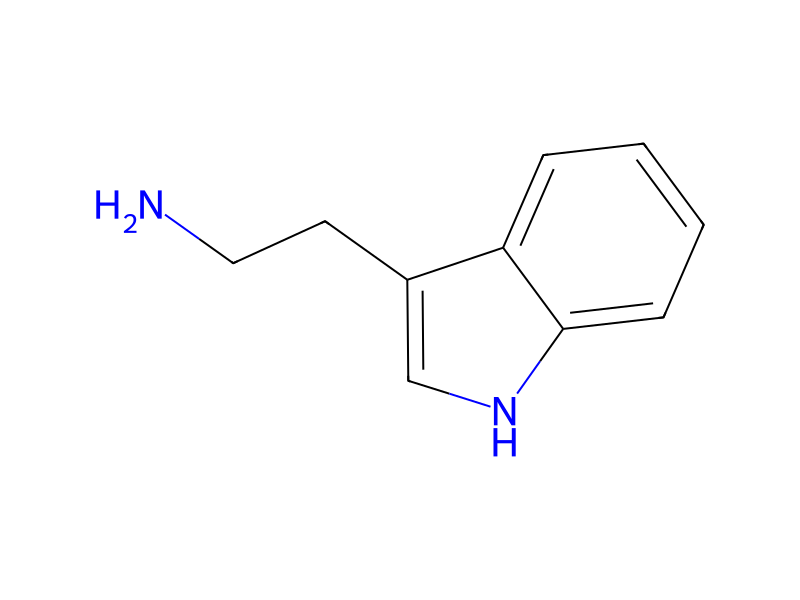


Product 1

Reagents, catalysts & solvents 1

Procedure
2.0 g of tryptamine (12.5 mmol) were dissolved in DCM (50 mL) and treated in one portion with triethylamine (1.74 mL. 12.5 mmol, 1 eq) and trityl chloride (3.44 g, 12.3 mmol). The resulting solution was stirred for 24 h at room temperature while protected from light. Volatiles were evaporated and the residue treated with aqueous HCl (1 N). The solid formed was filtered and washed with small portions of ether then dissolved in aqueous sodium hydrogen-carbonate and extracted into DCM. The organic layer was dried and evaporated to give 4.48 g (89% ) of 3-(N-trityl-(2-aminoethyl))-indole, which was used without further purification.
Workup
- customVolatiles were evaporated
- additionthe residue treated with aqueous HCl (1 N)
- customThe solid formed
- filtrationwas filtered
- washwashed with small portions of ether
- dissolutionthen dissolved in aqueous sodium hydrogen-carbonate
- extractionextracted into DCM
- customThe organic layer was dried
- customevaporated
Sources & evidence
- ORD record
- ord-228179ac3631451ea7f9261cd3a34edc
- Source dataset
- uspto-grants-2006_10
- Patent number
- US07119073B2
Reaction notes
Loading…