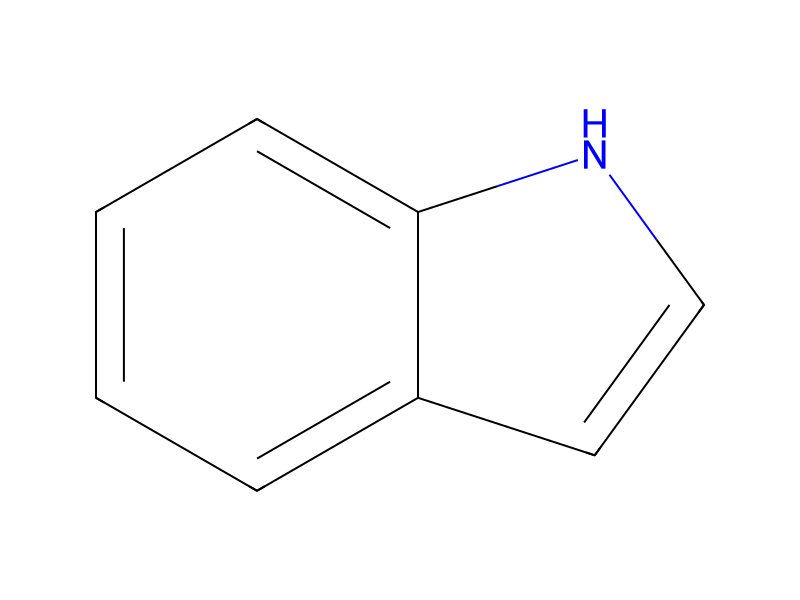
Indole → HCID 21906898, compound
Reaction equation

[NH:1]1[C:9]2[C:4](=[CH:5][CH:6]=[CH:7][CH:8]=2)[CH:3]=[CH:2]1.[C:10](Cl)(=[O:14])[C:11]([Cl:13])=[O:12].C1COCC1>C(OCC)C>[ClH:13].[NH:1]1[C:9]2[C:4](=[CH:5][CH:6]=[CH:7][CH:8]=2)[C:3]([C:10](=[O:14])[C:11]([Cl:13])=[O:12])=[CH:2]1Participants
5
Reactant 3


Product 1

Reagents, catalysts & solvents 1

Procedure
Indole, intermediate A1, is treated with oxalyl chloride, in a solvent such as THF or diethyl ether, to provide the 3-indolylglyoxalyl chloride hydrochloride salt, which is further treated with NaOMe in MeOH, to yield the methyl 3-indolylglyoxylate, intermediate B1. A second indole, A1, is converted to the acetamide intermediate C1, by stirring A1 with NaH in DMF, followed by the addition of iodoacetamide. Intermediates B1 and C1 are suspended in THF and treated with 3 to 4 equivalents of a base such as KOtBu, to provide compound 1, which falls under the general class of 3-(indol-3-yl)-4-(1N-indolyl)-1H-pyrrole-2,5-diones.
Sources & evidence
- ORD record
- ord-58e8b6653cff465ab0d08b0715b3963a
- Source dataset
- uspto-grants-2006_10
- Patent number
- US07129250B2
Reaction notes
Loading…