Potassium Iodide → 2,5-Dihydrofuran
Reaction equation

[I-].[K+].[CH3:3]/[C:4](/O[Al](O/C(/C)=C\C(C)=O)[O:11]/[C:12](/C)=[CH:13]\[C:14]([CH3:16])=O)=[CH:5]/[C:6](C)=[O:7].O1C(CC)=C1.I>[I-].[Zn+2].[I-].CN1CCCC1=O>[O:11]1[CH2:16][CH:14]=[CH:13][CH2:12]1.[CH:6](=[O:7])/[CH:5]=[CH:4]/[CH3:3]Participants
Reactant 4




Product 2


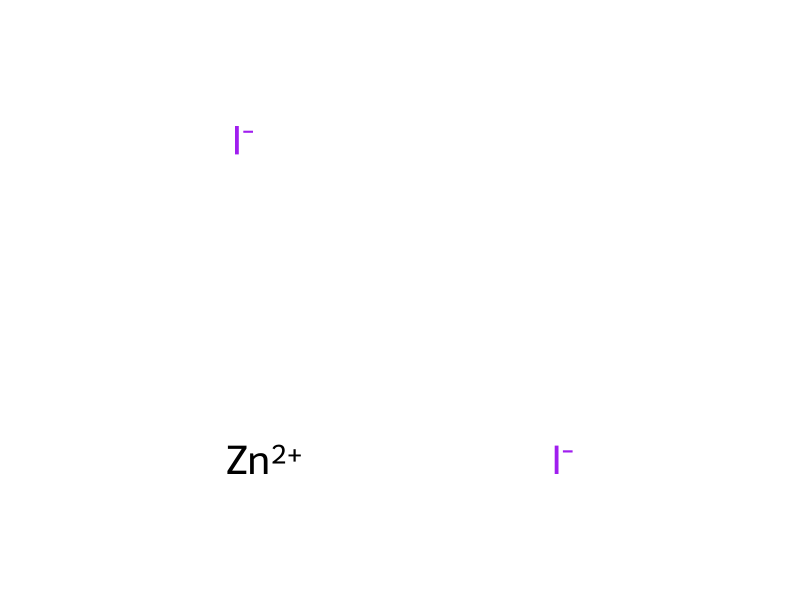
Reagents, catalysts & solvents 2

Procedure
In a 300 mL Fischer-Porter glass reactor were charged zinc iodide (3.0 g, 0.009 mol), potassium iodide (1.0 g, 0.006 mol), aluminum acetylacetonate (1.9 g, 0.006 mol), epoxybutene (30 g, 0.43 mol), hydrogen iodide (2.0 g, 0.009 mol), and N-methylpyrrolidone (120 g). The reactor was purged three times with nitrogen and was pressurized to 20 psig with nitrogen. The reactor was agitated by a magnetic stirrer and heated by an oil bath. The temperature was brought up to 120° C. and held at this temperature for 90 minutes. After cooling to room temperature, the reaction mixtures were analyzed by gas chromatography. GC indicated that all epoxybutene was consumed. Distillation of reaction mixtures afforded 2,5-dihydrofuran (16.3 g, 54% yield) and crotonaldehyde (1.5 g, 5%). Distillation under high vacuum afforded 10.2 grams of oligomer (34%).
Workup
- customThe reactor was purged three times with nitrogen
- temperatureheated by an oil bath
- customwas brought up to 120° C.
- customthe reaction mixtures
- customwas consumed
- distillationDistillation of reaction mixtures
Sources & evidence
- ORD record
- ord-29a55186d5314cf78f64f4ad08da191e
- Source dataset
- uspto-grants-2002_01
- Patent number
- US06335455B1
Reaction notes
Loading…