1-Decanol → L-lactide epsilon-caprolactone
Reaction equation

[CH3:1][C@@H:2]1[O:9][C:7](=[O:8])[C@H:6]([CH3:10])[O:5][C:3]1=[O:4].[C:11]1(=[O:18])[O:17][CH2:16][CH2:15][CH2:14][CH2:13][CH2:12]1.C(O)CCCCCCCCC.CCCCC(C([O-])=O)CC.CCCCC(C([O-])=O)CC.[Sn+2]>>[CH3:1][C@@H:2]1[O:9][C:7](=[O:8])[C@H:6]([CH3:10])[O:5][C:3]1=[O:4].[C:11]1(=[O:18])[O:17][CH2:16][CH2:15][CH2:14][CH2:13][CH2:12]1Participants


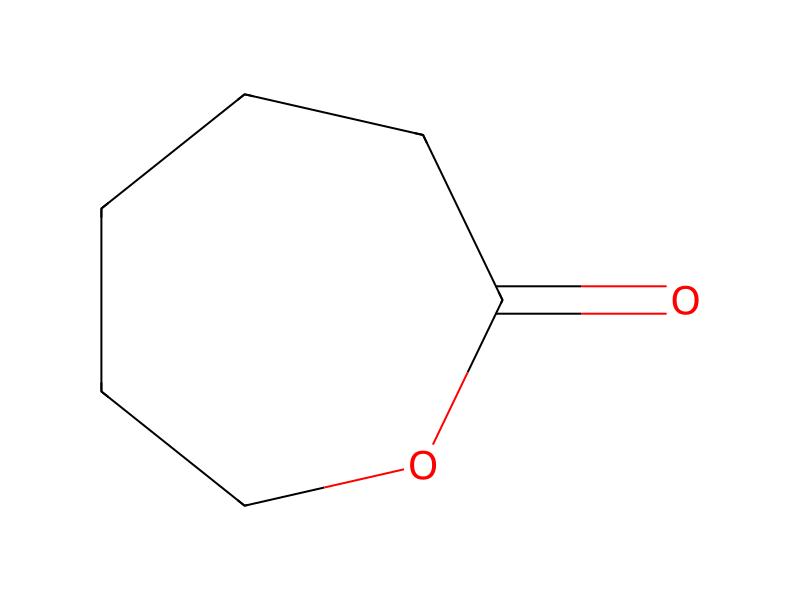
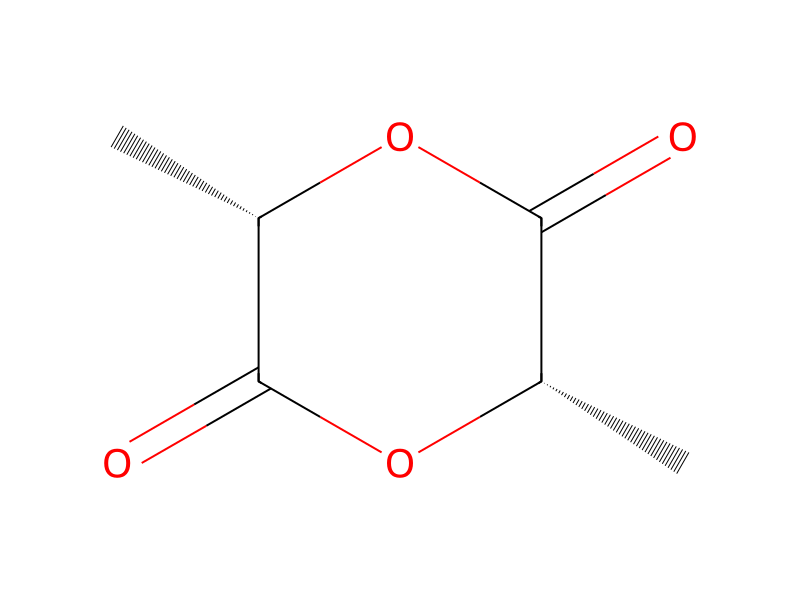
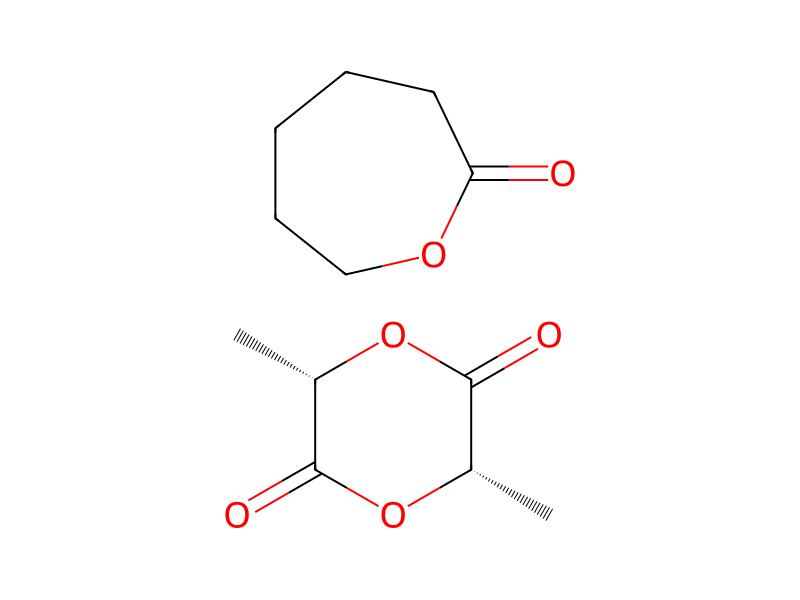
Conditions
- Temperature
- 140 °C
Procedure
In a typical reaction, l-lactide (6.67 moles, 960.5 g) and ε-caprolactone (0.35 moles, 39.9 g) were polymerized using decyl alcohol (7.02×10⁻³ moles, 1.11 g) as the initiator and stannous octoate (3.51×10⁻⁴ moles, 1.76 ml of 0.2 M solution in toluene) as the catalyst. The monomer to initiator ratio was 1,000 to 1; the monomer to catalyst ratio was 20,000 to 1. The reaction was carried out in a stainless steel resin kettle with a mechanical stirrer. The charge was dried under vacuum at 37° C. for 30 min. and 50° C. for 30 min. The monomer was then melted at 110° C. under positive argon pressure. Once melted, the charge was stirred at 32 rpm and heated to 140° C. After a short time at 140° C. the polymer solidified and could no longer be stirred. The polymerization was carried out for 48 hours at 140° C. followed by 16 hours at 120° C. The resulting polymer was characterized using GPC, DSC, viscosity, and carbon and proton NMR. The results for the three polymer lots made by this general method are summarized in Table I.
Workup
- customwere polymerized
- customThe charge was dried under vacuum at 37° C. for 30 min. and 50° C. for 30 min
- customat 140° C.
- stirringcould no longer be stirred
- waitfollowed by 16 hours at 120° C
- customThe results for the three polymer lots
Sources & evidence
- ORD record
- ord-79101a221dbd463a9ce780ef3b190ae6
- Source dataset
- uspto-grants-2002_01
- Patent number
- US06342065B1
Reaction notes
Loading…