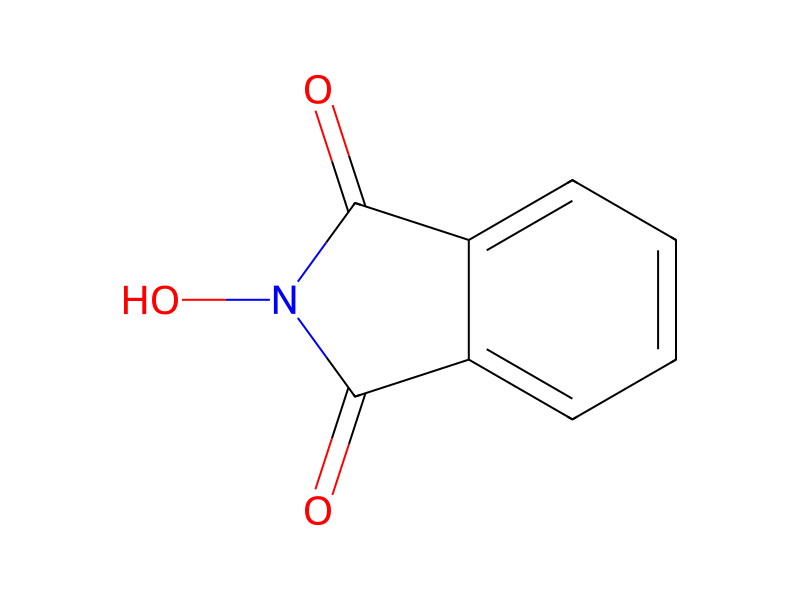
N-Hydroxyphthalimide → HCID 22131441, compound
Reaction equation

[OH:1][CH2:2][C:3]1[CH:4]=[N:5][C:6]2[C:11]([CH:12]=1)=[CH:10][CH:9]=[CH:8][CH:7]=2.C1(P(C2C=CC=CC=2)C2C=CC=CC=2)C=CC=CC=1.O[N:33]1[C:37](=[O:38])[C:36]2=[CH:39][CH:40]=[CH:41][CH:42]=[C:35]2[C:34]1=[O:43].CCOC(/N=N/C(OCC)=O)=O>C1COCC1>[N:5]1[C:6]2[C:11](=[CH:10][CH:9]=[CH:8][CH:7]=2)[CH:12]=[C:3]([CH2:2][O:1][N:33]2[C:34](=[O:43])[C:35]3=[CH:42][CH:41]=[CH:40][CH:39]=[C:36]3[C:37]2=[O:38])[CH:4]=1Participants
6





Procedure
3-(hydroxymethyl)quinoline (400 mg, 2.52 mmol), triphenyl phosphine (692 mg, 2.64 mmol, 1.05 equiv) and N-hydroxyphthalimide (430 mg, 2.64 mmol, 1.05 equiv) were dissolved in 10 mL of dry THF. Diethylazodicarboxylate (0.44 mL, 2.80 mmol, 1.11 equiv) was then added dropwise and the reaction was stirred overnight. The reaction mixture placed in a freezer for 2 hours, and then filtered to give the desired product (0.69 g) as a fluffy white solid. MS(CI) m/e 305 (M+H)+.
Workup
- waitThe reaction mixture placed in a freezer for 2 hours
- filtrationfiltered
Sources & evidence
- ORD record
- ord-042e45ebdec34d1d88c45a6b2bb0cac2
- Source dataset
- uspto-grants-2007_04
- Patent number
- USRE039591E1
Reaction notes
Loading…