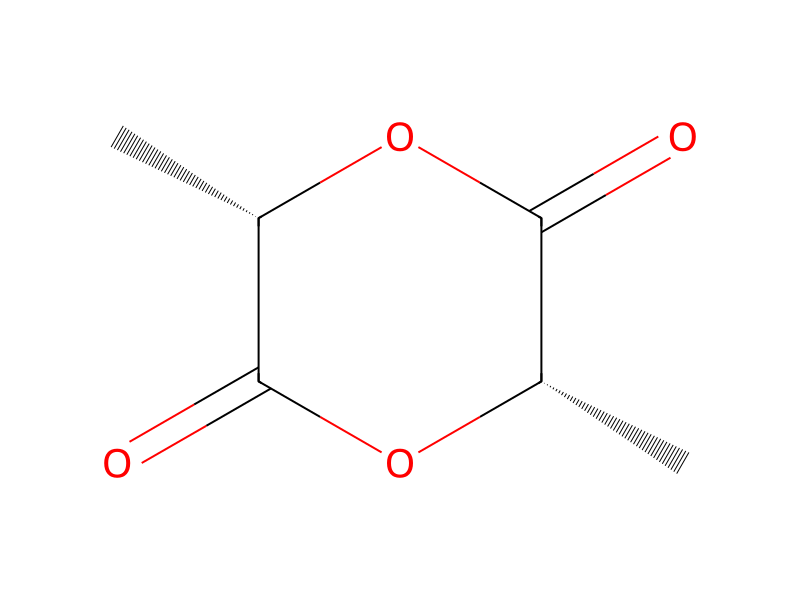
Glycolide → Hydroxyacetic acid--2-hydroxypropanoic acid (1/1)
Reaction equation

[CH3:1][C@@H:2]1[O:9]C(=O)[C@H](C)[O:5][C:3]1=[O:4].C1OC(=O)COC1=O>>[C:3]([OH:5])(=[O:4])[CH2:2][OH:9].[C:3]([OH:5])(=[O:4])[CH:2]([CH3:1])[OH:9]Participants


Procedure
A PFA-made cylinder was charged with 100 g of recrystallized L-(-)-lactide and 100 g of glycolide, and the contents were dried at room temperature for about 30 minutes while introducing nitrogen gas. Then, 0.048 g of tin octanoate as a catalyst was added, and the contents were held at 130° C. for 20 hours while introducing nitrogen gas therein, thereby polymerizing the monomers. After completion of the polymerization, a bulk polymer taken out of the cylinder was ground into fine particles having a particle size of about 3 mm or smaller, and the fine particles were dried overnight at about 50° C. under reduced pressure of about 0.1 kPa to remove remaining monomers, thereby obtaining a glycolic acid/lactic acid copolymer [Polymer (P-C3)]. The same process was conducted repeatedly to prepare a necessary amount of Polymer (P-C3). The polymer thus obtained had a glass transition temperature, Tg of about 44° C. and was a noncrystalline amorphous substance.
Workup
- customthe contents were dried at room temperature for about 30 minutes
- additionwhile introducing nitrogen gas
- additionThen, 0.048 g of tin octanoate as a catalyst was added
- additionwhile introducing nitrogen gas
- custompolymerizing the monomers
- customAfter completion of the polymerization
- customthe fine particles were dried overnight at about 50° C. under reduced pressure of about 0.1 kPa
- customto remove
Sources & evidence
- ORD record
- ord-5958ba3f6a7842929054467883e6c635
- Source dataset
- uspto-grants-2000_12
- Patent number
- US06159416
Reaction notes
Loading…