Trityl chloride → (S)-Glycidyl Trityl Ether
Reaction equation

[C:1](Cl)([C:14]1[CH:19]=[CH:18][CH:17]=[CH:16][CH:15]=1)([C:8]1[CH:13]=[CH:12][CH:11]=[CH:10][CH:9]=1)[C:2]1[CH:7]=[CH:6][CH:5]=[CH:4][CH:3]=1.[CH2:21]1[O:23][C@H:22]1[CH2:24][OH:25].C(N(CC)CC)C>C(Cl)Cl>[C:2]1([C:1]([O:25][CH2:24][C@H:22]2[O:23][CH2:21]2)([C:14]2[CH:19]=[CH:18][CH:17]=[CH:16][CH:15]=2)[C:8]2[CH:13]=[CH:12][CH:11]=[CH:10][CH:9]=2)[CH:7]=[CH:6][CH:5]=[CH:4][CH:3]=1Participants
5
Reactant 3


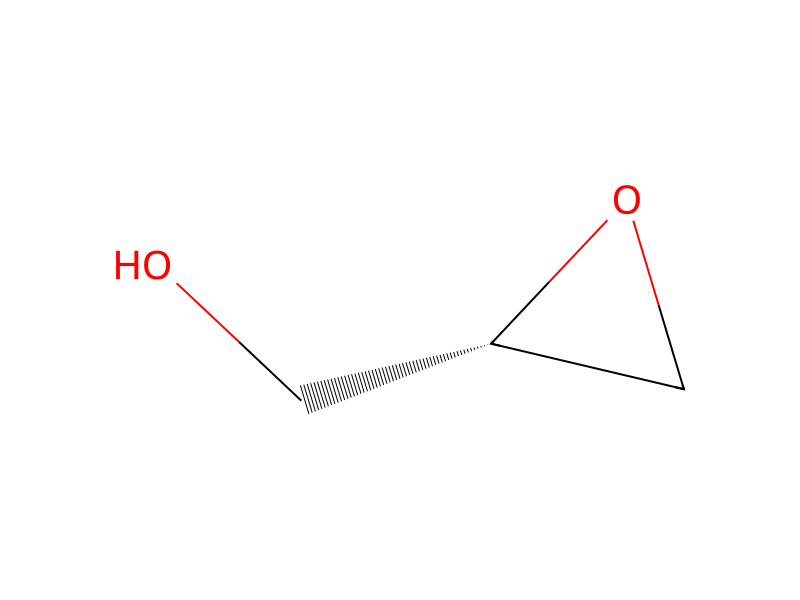
Product 1

Reagents, catalysts & solvents 1

Procedure
A solution of trityl chloride (48.25 g, 173 mmol) in anhydrous CH2Cl2 (150 mL) was added to a stirred solution of (S)-(−)-glycidol (12.21 g, 164 mmol) and triethylamine (34.5 mL, 247 mmol) in anhydrous CH2Cl2 (250 mL) at −20° C. under a N2 atmosphere. After 2 h, CH2Cl2 was removed under vacuum. The mixture was taken up in EtOAc (500 mL) before it was washed with H2O (2×200 mL). The organic layer was dried, filtered and concentrated to give the crude title compound (67.9 g) contaminated with trityl alcohol, which can be removed by chromatography.
Workup
- customCH2Cl2 was removed under vacuum
- washwas washed with H2O (2×200 mL)
- customThe organic layer was dried
- filtrationfiltered
- concentrationconcentrated
Sources & evidence
- ORD record
- ord-94ef27e361bd43e4beb172d5094a3702
- Source dataset
- uspto-grants-2002_09
- Patent number
- US06448422B1
Reaction notes
Loading…