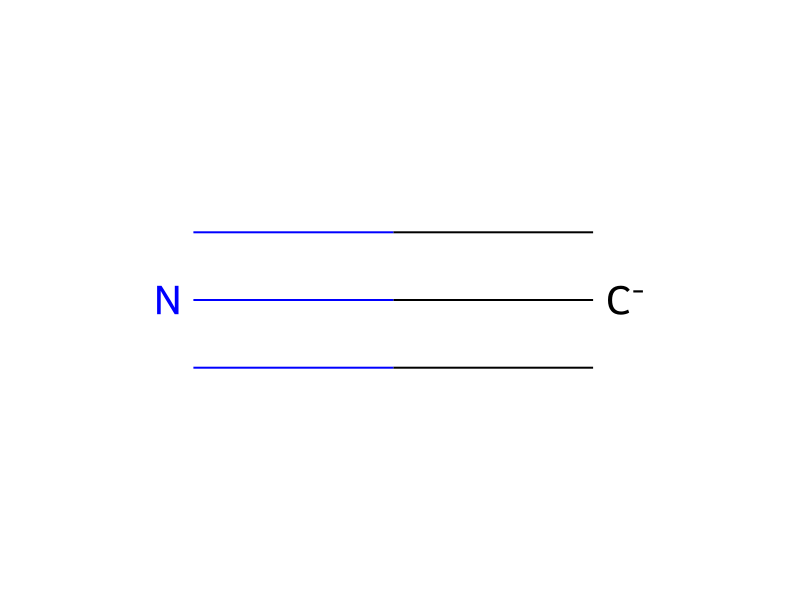
Cyanide → HCID 68144827, compound
Reaction equation

[CH3:1][N:2]1[C:16]2[C:17]3[C:4]([CH2:5][C@@H:6]4[C@@:11]([O:18][CH3:19])([C:12]=3[CH:13]=[CH:14][CH:15]=2)[CH2:10][C@@H:9]([CH2:20]Cl)[CH2:8][N:7]4[CH3:22])=[CH:3]1.[C-:23]#[N:24].[Na].[C-]#N.[K+]>CS(C)=O>[CH3:1][N:2]1[C:16]2[C:17]3[C:4]([CH2:5][C@@H:6]4[C@@:11]([O:18][CH3:19])([C:12]=3[CH:13]=[CH:14][CH:15]=2)[CH2:10][C@@H:9]([CH2:20][C:23]#[N:24])[CH2:8][N:7]4[CH3:22])=[CH:3]1Participants
Reactant 4



Product 1

Reagents, catalysts & solvents 1

Procedure
The starting material for preparing compounds of the present invention is, preferably, 1-methyl-lumilysergol-10-methylether or 1,6-dimethyl-8β-hydroxymethyl-10α-methoxyergoline (I), described and claimed in the Bernardi et al. U.S. Pat. No. 3,228,943. It is reacted at a temperature between 40° and 50° C with the chloride of an aryl- or alkylsulphonic-acid, such as tosyl chloride or mesyl chloride, in pyridine and in the presence of pyridinium chloride, to give the corresponding 8-chloromethyl derivative. This compound, that is, 1,6-dimethyl-8β-chloromethyl-10α-methoxyergoline (II), is treated with an alkaline cyanide, such as sodium or potassium cyanide in a suitable solvent, such as dimethylsulphoxide, at the temperature of 100°-120° C for a period between 4 and 8 hours. The product thus formed, that is, 1,6-dimethyl-8β-cyanomethyl-10α-methoxyergoline (III), is isolated and characterized: it has never been described in the previous literature. This product is subjected to alkaline hydrolysis, preferably with potassium hydroxide in water/ethanol/dioxan solution, under reflux conditions for a few hours.
Workup
- customThe product thus formed
Sources & evidence
- ORD record
- ord-520cee4968374f529dd097573e73f735
- Source dataset
- uspto-grants-1976_08
- Patent number
- US03972883
Reaction notes
Loading…