Ammonia → HCID 15075950, compound
Reaction equation

[Cl:1][C:2]1[CH:3]=[C:4]([C:8]2([OH:22])[C:16]3[C:11](=[CH:12][CH:13]=[CH:14][CH:15]=3)[N:10]([CH2:17][CH2:18][C:19]#[N:20])[C:9]2=[O:21])[CH:5]=[CH:6][CH:7]=1.N.[H][H].Cl.NCCCN1C2C(=CC=CC=2)C(C2C=CC=C(Cl)C=2)(O)C1=O.Cl>[Ni].C(O)C.CCOCC.C(O)(C)C>[NH2:20][CH2:19][CH2:18][CH2:17][N:10]1[C:11]2[C:16](=[CH:15][CH:14]=[CH:13][CH:12]=2)[C:8]([C:4]2[CH:5]=[CH:6][CH:7]=[C:2]([Cl:1])[CH:3]=2)([OH:22])[C:9]1=[O:21]Participants
10
Reactant 5



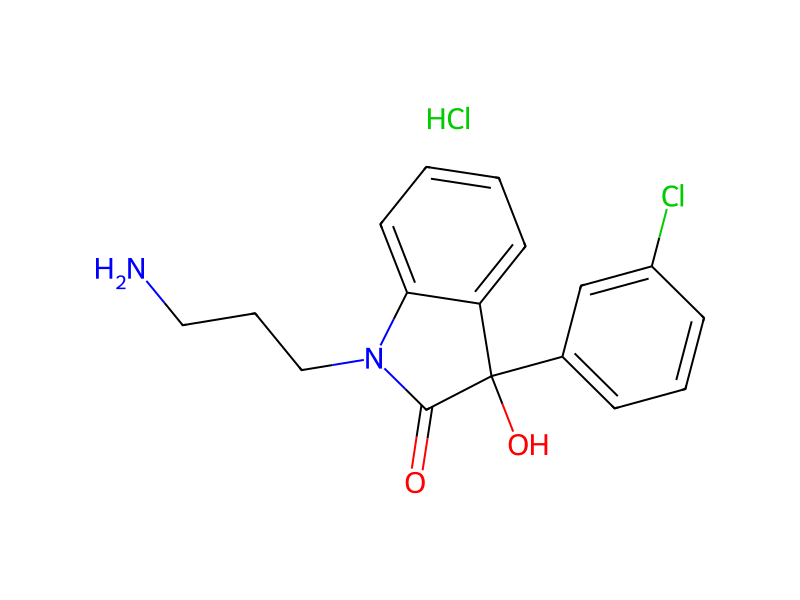

Product 1

Reagents, catalysts & solvents 4




Procedure
The nitrile of Example 1 (1.57 g.) was reduced at 40 p.s.i. and 40°C in the presence of Raney Nickel W2 (2.g.) in absolute ethanol half saturated with dry ammonia (50 ml.). Uptake ceased when slightly more than 2 equivalents of hydrogen had been taken up. The catalyst was filtered off, the ethanol solution evaporated to leave a green oil which gave 1.22 g. microcrystals, m.p. 250°-252°(decomp), of 1-(3-aminopropyl)- 3-(m-chlorophenyl)- 3-hydroxyindolin-2-one hydrochloride on treatment with isopropanol and hydrogen chloride in dry ether.
Workup
- custom40°C
- filtrationThe catalyst was filtered off
- customthe ethanol solution evaporated
- customto leave a green oil which
- customgave 1.22 g
Sources & evidence
- ORD record
- ord-262cb73b397a4850b64e3329c26beb4d
- Source dataset
- uspto-grants-1976_08
- Patent number
- US03976645
Reaction notes
Loading…