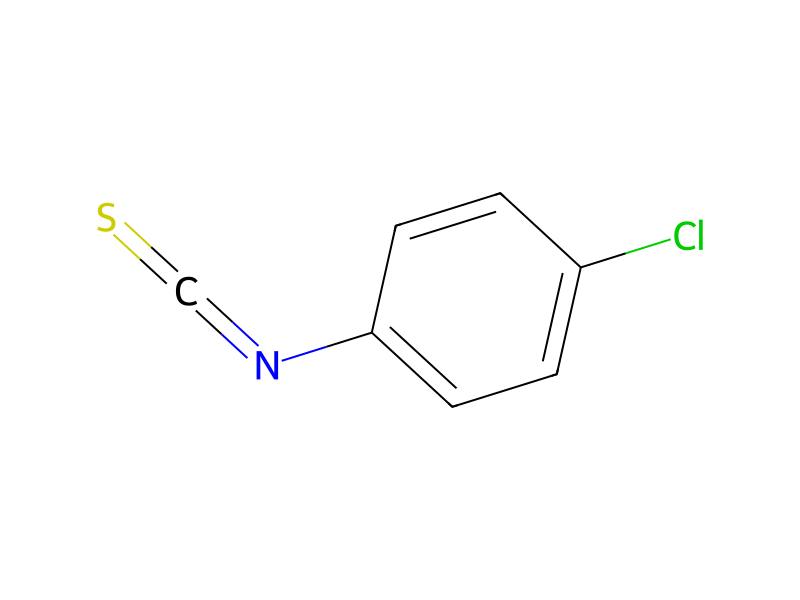
4-Chlorophenyl isothiocyanate → HCID 178483422, compound
Reaction equation

[Na].Cl.Cl.CN(C)CCCCCCCCCCC(N)=N.ClC1C=CC(N=C=S)=CC=1.Cl.Cl.[Cl:32][C:33]1[CH:38]=[CH:37][C:36]([NH:39][C:40]([NH:42][C:43](=[NH:57])[CH2:44][CH2:45][CH2:46][CH2:47][CH2:48][CH2:49][CH2:50][CH2:51][CH2:52][CH2:53][N:54]([CH3:56])[CH3:55])=[S:41])=[CH:35][CH:34]=1>C(O)(C)C.CC(C)=O>[Cl:32][C:33]1[CH:34]=[CH:35][C:36]([NH:39][C:40]([NH:42][C:43](=[NH:57])[CH2:44][CH2:45][CH2:46][CH2:47][CH2:48][CH2:49][CH2:50][CH2:51][CH2:52][CH2:53][N:54]([CH3:56])[CH3:55])=[S:41])=[CH:37][CH:38]=1Participants
7





Procedure
Following a procedure similar to that described in Example 42 but using 2.8 g. sodium in 300 ml. dry acetone, 18.5 g. 11-(dimethylamino)undecanamidine dihydrochloride, and 11.9 g. 4-chlorophenyl isothiocyanate in 100 ml. dry acetone there was obtained 10.4 g. 1-(4-chlorophenyl)-3-[11-(dimethylamino)undecanimidoyl]-2-thiourea dihydrochloride; m.p. 130°-132°C. (from isopropyl alcohol).
Sources & evidence
- ORD record
- ord-f72f554cb4b74c33b655fdb1c1ff6301
- Source dataset
- uspto-grants-1976_10
- Patent number
- US03984467
Reaction notes
Loading…