Benzoic Acid → 4-Hydroxybenzoic Acid
Reaction equation

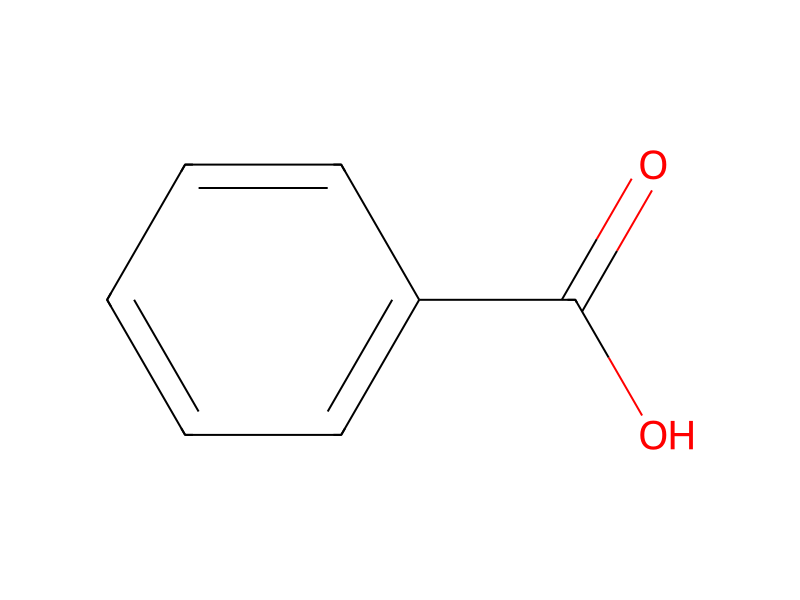
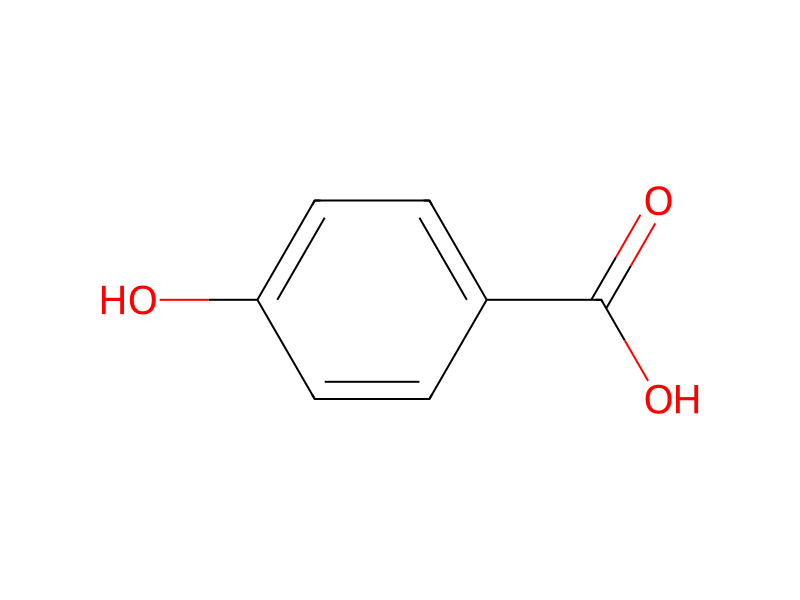
[C:1]([OH:9])(=[O:8])[C:2]1[CH:7]=[CH:6][CH:5]=[CH:4][CH:3]=1.[OH2:10].[OH-].[Na+].OO>C(#N)C>[OH:10][C:3]1[CH:4]=[CH:5][CH:6]=[CH:7][C:2]=1[C:1]([OH:9])=[O:8].[OH:10][C:4]1[CH:3]=[C:2]([CH:7]=[CH:6][CH:5]=1)[C:1]([OH:9])=[O:8].[OH:10][C:5]1[CH:6]=[CH:7][C:2]([C:1]([OH:9])=[O:8])=[CH:3][CH:4]=1Participants
Reactant 4



Product 3


Reagents, catalysts & solvents 1

Conditions
- Temperature
- 50 °C
Procedure
To a stainless steel autoclave containing 20.0 grams of acetonitrile is charged 122.0 grams (1.0 mole) of benzoic acid and 500 grams of water containing 200 grams (5.0 mole) of sodium hydroxide. Following this, 12.0 grams of a 30% aqueous hydrogen peroxide solution is added to the autoclave during a period of 20 minutes. During the addition of the aqueous hydrogen peroxide solution, the autoclave is maintained at a temperature of 50° C. and atmospheric pressure. At the end of the addition time, heating is discontinued, the autoclave is allowed to return to room temperature and the reaction product is transferred to a clean dry beaker. The product is acidified, extracted with ether and the ether layer is evaporated to produce a crude product. Fractional crystallization of the crude product in water and alcohol will yield essentially pure 2-hydroxybenzoic acid, 3-hydroxybenzoic acid and 4-hydroxybenzoic acid.
Workup
- additionis added to the autoclave during a period of 20 minutes
- temperatureAt the end of the addition time, heating
- customto return to room temperature
- extractionextracted with ether
- customthe ether layer is evaporated
- customto produce a crude product
- customFractional crystallization of the crude product in water and alcohol
Sources & evidence
- ORD record
- ord-b996117cd81c4f0ba148f008b324385b
- Source dataset
- uspto-grants-1976_10
- Patent number
- US03985796
Reaction notes
Loading…