1,3-Dibromopropane → 1-(3-Bromo-propyl)-1H-indazole
Reaction equation

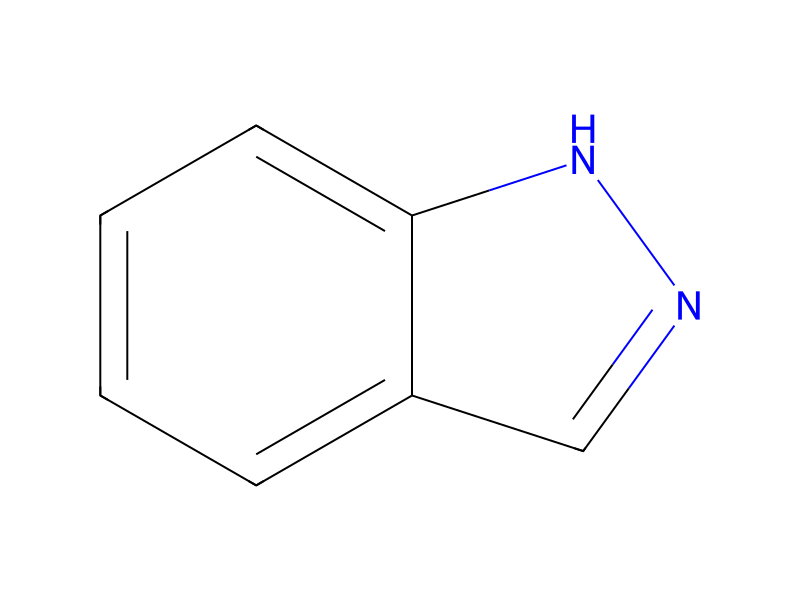
[Br:1][CH2:2][CH2:3][CH2:4]Br.[NH:6]1[C:14]2[C:9](=[CH:10][CH:11]=[CH:12][CH:13]=2)[CH:8]=[N:7]1.[OH-].[K+].C(OCC)(=O)C>CN(C=O)C.O>[Br:1][CH2:2][CH2:3][CH2:4][N:6]1[C:14]2[C:9](=[CH:10][CH:11]=[CH:12][CH:13]=2)[CH:8]=[N:7]1Participants
7






Procedure
1,3-Dibromopropane (508 μl, 5.0 mmol)) was dissolved in 10 mL DMF and placed in a 100 mL flask. Indazole (592 mg, 5.0 mmol) and KOH (282 mg, 5.0 mmol) were added and the suspension was stirred overnight at room temperature. Ethyl acetate (50 mL) and water (50 mL) were added. Phases were separated and the aqueous phase was re-extracted with ethyl acetate (50 mL). The combined organic phases were washed with brine, dried over magnesium sulphate and evaporated to dryness to produce 751 mg of a yellow oil. Crude product was further purified by column chromatography (0–10% methanol:dichloromethane) to produce pure 22 (169 mg, 14%).
Workup
- customplaced in a 100 mL flask
- customPhases were separated
- extractionthe aqueous phase was re-extracted with ethyl acetate (50 mL)
- washThe combined organic phases were washed with brine
- dry with materialdried over magnesium sulphate
- customevaporated to dryness
Sources & evidence
- ORD record
- ord-283feb495c7f43b9b0e0ac5a3860bda1
- Source dataset
- uspto-grants-2007_07
- Patent number
- US07238713B2
Reaction notes
Loading…