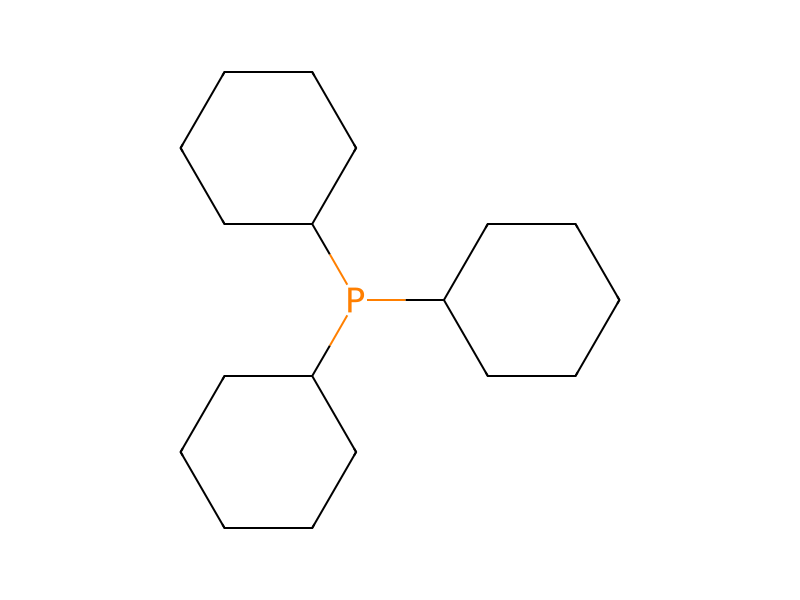
Tricyclohexylphosphine → 2,3-Dihydro-5-[4-(phenylmethoxy)phenyl]-1H-inden-1-one
Reaction equation

[CH2:1]([O:8][C:9]1[CH:14]=[CH:13][C:12](B(O)O)=[CH:11][CH:10]=1)[C:2]1[CH:7]=[CH:6][CH:5]=[CH:4][CH:3]=1.Br[C:19]1[CH:20]=[C:21]2[C:25](=[CH:26][CH:27]=1)[C:24](=[O:28])[CH2:23][CH2:22]2.C1(P(C2CCCCC2)C2CCCCC2)CCCCC1.[F-].[K+]>O1CCOCC1.C([O-])(=O)C.[Pd+2].C([O-])(=O)C>[CH2:1]([O:8][C:9]1[CH:14]=[CH:13][C:12]([C:19]2[CH:20]=[C:21]3[C:25](=[CH:26][CH:27]=2)[C:24](=[O:28])[CH2:23][CH2:22]3)=[CH:11][CH:10]=1)[C:2]1[CH:7]=[CH:6][CH:5]=[CH:4][CH:3]=1Participants
7
Reactant 4



Product 1

Reagents, catalysts & solvents 2


Procedure
A solution of 4-benzyloxyphenyl boronic acid (0.15 g, 0.66 mmol), 5-bromo-1-indanone (0.10 g, 0.44 mmol), palladium acetate (2.0 mg, 0.009 mmol), tricyclohexylphosphine (7.0 mg, 0.018 mmol) and potassium fluoride (0.077 g, 1.32 mmol) in dioxane (2.5 mL) was stirred at 75° C. for 3 h. The reaction mixture was filtered through celite. Silica gel chromatography eluting with 25% ethyl acetate/hexane gave 0.05 g of desired product: 1H NMR (500 MHz, CDCl3) δ 7.85 (d, J=8.0 Hz, 1H), 7.68 (s, 1H), 7.62 (t, 3H), 7.51 (d, J=7.3 Hz, 2H), 7.46 (t, J=7.5 Hz, 2H), 7.38–7.42 (m, 1H), 7.13 (d, J=8.7 Hz, 2H), 5.18 (s, 2H), 3.23 (t, J=5.8 Hz, 2H), 2.78 (t, J=6.0 Hz, 2H).
Workup
- filtrationThe reaction mixture was filtered through celite
- washSilica gel chromatography eluting with 25% ethyl acetate/hexane
Sources & evidence
- ORD record
- ord-2e24334c459c46f6a89d408fe879391b
- Source dataset
- uspto-grants-2007_05
- Patent number
- US07220734B2
Reaction notes
Loading…