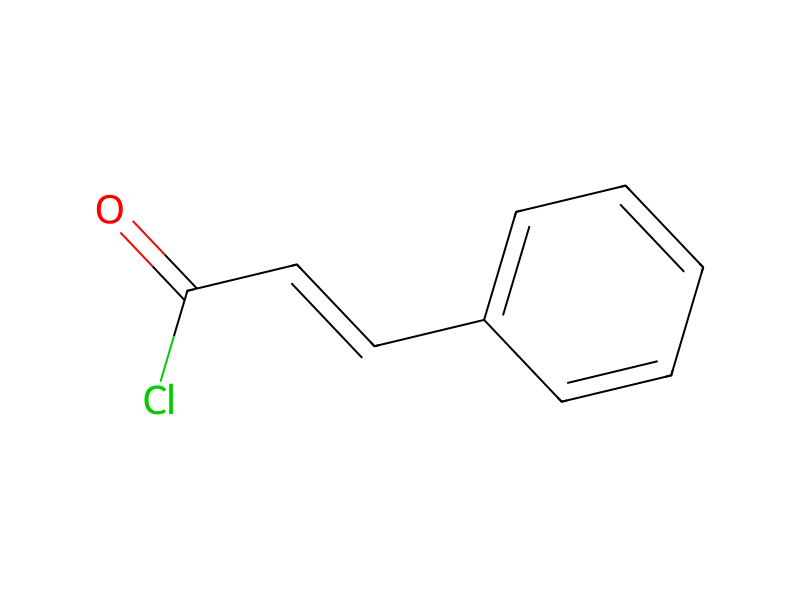
Benzaldehyde → 3-Phenylprop-2-enoyl chloride
Reaction equation

[C:1]([OH:11])(=O)[CH:2]=[CH:3][C:4]1[CH:9]=[CH:8][CH:7]=[CH:6][CH:5]=1.C(=O)C1C=CC=CC=1.C(O)(=O)CC(O)=O.S(Cl)([Cl:29])=O>N1C=CC=CC=1.N1CCCCC1>[C:1]([Cl:29])(=[O:11])[CH:2]=[CH:3][C:4]1[CH:9]=[CH:8][CH:7]=[CH:6][CH:5]=1Participants
7
Reactant 4



Product 1
Reagents, catalysts & solvents 2


Procedure
FIG. 1 shows the synthesis of a cellulose cinnamate according to an embodiment of the present invention. A cinnamic acid is first prepared by reacting a benzaldehyde with malonic acid in pyridine and piperidine. The cinnamic acid is then reacted with thionyl chloride to produce a cinnamoyl chloride derivative. The CelCN is finally synthesized by reacting cellulose, or cellulose acetate, with the cinnamoyl chloride derivative in an inert solvent (such as chloroform, nitrobenzene, chlorobenzene, or the like). The reaction mixture is diluted with methanol, filtered, dried in a vacuum, and milled by a vibrating mill, whereupon the CelCN is obtained.
Sources & evidence
- ORD record
- ord-5dc7bba665ae446cb1cc9c267fd66fac
- Source dataset
- uspto-grants-2003_06
- Patent number
- US06572939B2
Reaction notes
Loading…