Cesium carbonate → 4-Fluoro-4'-hydroxybiphenyl
Reaction equation

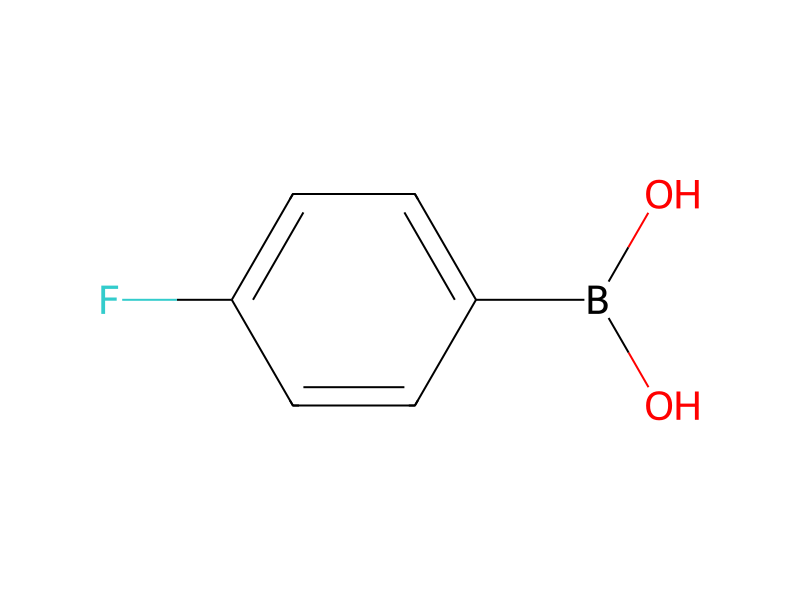
I[C:2]1[CH:7]=[CH:6][C:5]([OH:8])=[CH:4][CH:3]=1.[F:9][C:10]1[CH:15]=[CH:14][C:13](B(O)O)=[CH:12][CH:11]=1.C(=O)([O-])[O-].[Cs+].[Cs+]>CN(C=O)C.C(OCC)(=O)C.C1C=CC([P]([Pd]([P](C2C=CC=CC=2)(C2C=CC=CC=2)C2C=CC=CC=2)([P](C2C=CC=CC=2)(C2C=CC=CC=2)C2C=CC=CC=2)[P](C2C=CC=CC=2)(C2C=CC=CC=2)C2C=CC=CC=2)(C2C=CC=CC=2)C2C=CC=CC=2)=CC=1>[F:9][C:10]1[CH:15]=[CH:14][C:13]([C:2]2[CH:7]=[CH:6][C:5]([OH:8])=[CH:4][CH:3]=2)=[CH:12][CH:11]=1Participants
7






Procedure
A mixture under N2 in DMF (18 mL) of 4-iodophenol (2.00 g, 9.09 mmol), 4-fluorophenylboronic acid (1.40 g, 10.0 mmol), cesium carbonate (4.44 g, 13.6 mmol), and tetrakis(triphenylphosphine)palladium(0) (0.27 g, 0.23 mmol) was stirred for 10 minutes at ambient temperature and then overnight at reflux. The reaction mixture was cooled to ambient temperature, diluted with ethyl acetate, and extracted twice with water. The organic phase was washed with brine, dried over Na2SO4, filtered, and concentrated in vacuo. Chromatography on silica gel (10:1, then 5:1 hexanes-ethyl acetate) gave 4-(4-fluorophenyl)phenol (0.79 g, 46%) as a white powder.
Workup
- temperatureovernight at reflux
- extractionextracted twice with water
- washThe organic phase was washed with brine
- dry with materialdried over Na2SO4
- filtrationfiltered
- concentrationconcentrated in vacuo
Sources & evidence
- ORD record
- ord-8d231b41ed7d4dc1a914ecab9366b1d6
- Source dataset
- uspto-grants-1997_09
- Patent number
- US05665777
Reaction notes
Loading…