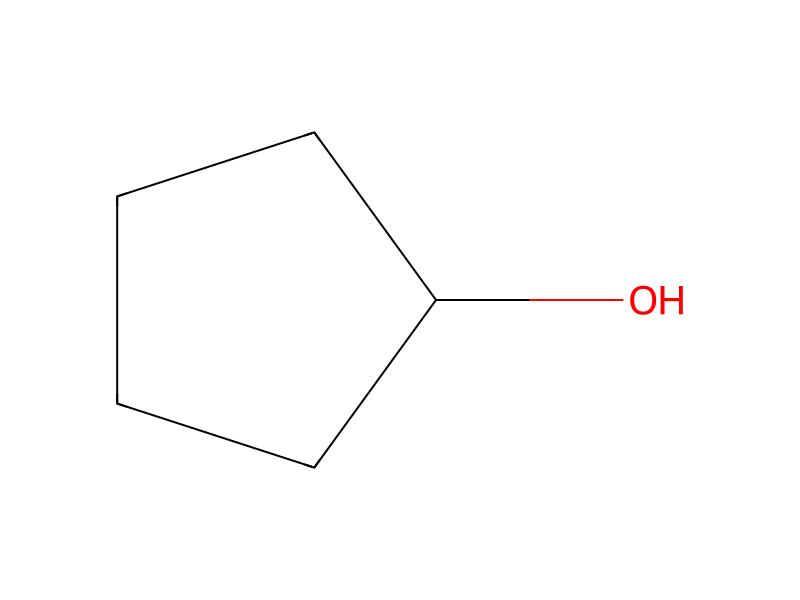
Cyclopentanol → HCID 21187847, compound
Reaction equation

N(C(OC(C)C)=O)=NC(OC(C)C)=O.[OH:15][C:16]1[CH:17]=[C:18]([CH:23]=[CH:24][C:25]=1[O:26][C:27]([F:30])([F:29])[F:28])[C:19]([O:21][CH3:22])=[O:20].[CH:31]1(O)[CH2:35][CH2:34][CH2:33][CH2:32]1.C1(P(C2C=CC=CC=2)C2C=CC=CC=2)C=CC=CC=1>O1CCCC1>[CH:31]1([O:15][C:16]2[CH:17]=[C:18]([CH:23]=[CH:24][C:25]=2[O:26][C:27]([F:28])([F:29])[F:30])[C:19]([O:21][CH3:22])=[O:20])[CH2:35][CH2:34][CH2:33][CH2:32]1Participants
6
Reactant 4



Product 1

Reagents, catalysts & solvents 1

Procedure
Diisopropyl azodicarboxylate (0.61 mL) is added to a solution of methyl 3-hydroxy-4-trifluoromethoxybenzoate (0.74 g), cyclopentanol (0.19 g) and triphenylphosphine (0.81 g) in tetrahydrofuran (10 mL) and the mixture is heated overnight at reflux. Solvent is evaporated off under reduced pressure and the resulting yellow oil is triturated with diethyl ether. The white solid thus formed is filtered off, and the filtrate is evaporated under reduced pressure and subjected to mplc, to give methyl 3-cyclopentyloxy-4-trifluoromethoxy-benzoate in the form of a pale yellow oil (0.6 g).
Workup
- temperaturethe mixture is heated overnight
- temperatureat reflux
- customSolvent is evaporated off under reduced pressure
- customthe resulting yellow oil is triturated with diethyl ether
- customThe white solid thus formed
- filtrationis filtered off
- customthe filtrate is evaporated under reduced pressure
Sources & evidence
- ORD record
- ord-5cfb653739444feb9fff9bafb3386988
- Source dataset
- uspto-grants-2001_07
- Patent number
- US06255326B1
Reaction notes
Loading…