Potassium Chloride → 2-Chloro-1,1,1-trifluoroethane
Reaction equation

[C:1]([O-:4])(=[O:3])[CH3:2].[K+].[C:6]([CH2:10][Cl:11])([F:9])([F:8])[F:7].[Cl-].[K+].[F-].[K+]>CN1CCCC1=O.O>[C:6]([CH2:10][Cl:11])([F:9])([F:8])[F:7].[C:6]([CH2:10][O:3][C:1]([CH3:2])=[O:4])([F:9])([F:8])[F:7]Participants
Reactant 4
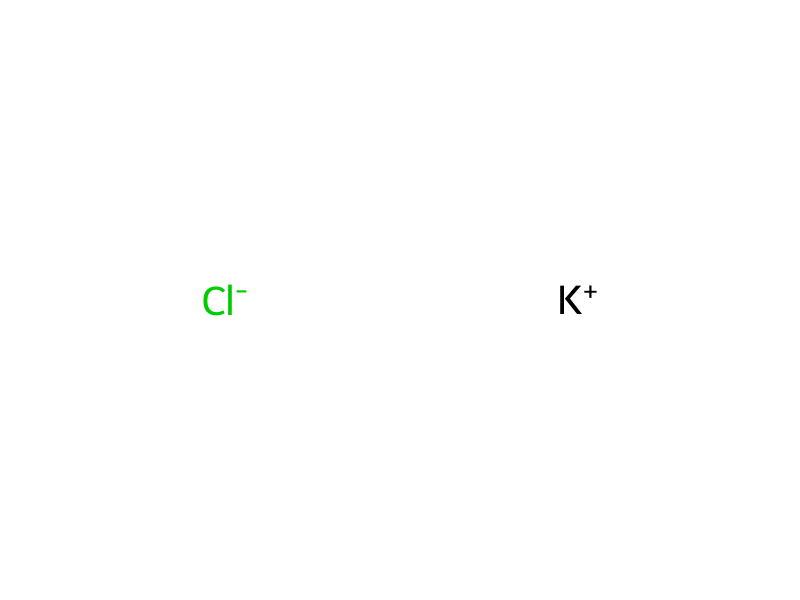



Product 2

Reagents, catalysts & solvents 2


Conditions
- Temperature
- 140 °C
Procedure
A pressure vessel containing 8009 g of powdered potassium acetate was heated to 140° C. and evacuated to a pressure of 0.4 mm Hg for 4 hrs. removing 87 grams of water and acetic acid. To the remaining potassium acetate (7922 g, 80.7 mols) 11,800 g of N-methyl-2-pyrrolidone (NMP) containing 10 parts per million water was added. Then 95 mols of CF3CH2Cl containing 62 parts per million water was also added. As the mixture was heated to 180° C., the pressure rose to about 200 pounds per square inch (psig). For the next 4.3 hours, as the pressure dropped, CF3CH2Cl was added as necessary to keep the pressure near 200 psig. A total of 14,350 g (121.1 mols) of CF3CH2Cl was added to the reactor. After another 6.1 hours at 180° C., the reaction pressure had fallen to 173 psig and appeared to be no longer dropping appreciably. The reaction vessel was cooled to near room temperature and filtered with the filtrate entering a still. The remaining liquid products were washed from the salts on the filter into the still with an additional 65.6 mols of CF3CH2Cl leaving behind 69.3 mols of potassium chloride (85.9% conversion of the potassium acetate) and 0.50 mol of potassium fluoride (0.24% loss based on the reacted CF3CH2Cl). The distillation yielded 111.5 mols of unreacted CF3CH2Cl and 66.1 mols of the CF3CH2O2CCH3 leaving behind 11,655 g of dry NMP to be reused.
Workup
- customevacuated to a pressure of 0.4 mm Hg for 4 hrs
- customremoving 87 grams of water and acetic acid
- additionwas added
- temperatureAs the mixture was heated to 180° C.
- additionFor the next 4.3 hours, as the pressure dropped
- customthe reaction pressure
- temperatureThe reaction vessel was cooled to near room temperature
- filtrationfiltered with the filtrate
- washThe remaining liquid products were washed from the salts on the
- distillationThe distillation
Sources & evidence
- ORD record
- ord-56a145a601904c1cab3dc1a0e92d88f0
- Source dataset
- uspto-grants-1984_02
- Patent number
- US04434297
Reaction notes
Loading…