Sodium hydride → (2R,3R)-3-(5-bromo-2-chloropyrimidin-4-yloxy)butan-2-ol
Reaction equation

[CH3:1][C@@H:2]([OH:6])[C@H:3]([OH:5])[CH3:4].[H-].[Na+].[Br:9][C:10]1[C:11](Cl)=[N:12][C:13]([Cl:16])=[N:14][CH:15]=1>C1COCC1>[Br:9][C:10]1[C:11]([O:5][C@H:3]([CH3:4])[C@H:2]([OH:6])[CH3:1])=[N:12][C:13]([Cl:16])=[N:14][CH:15]=1Participants
5
Reactant 3


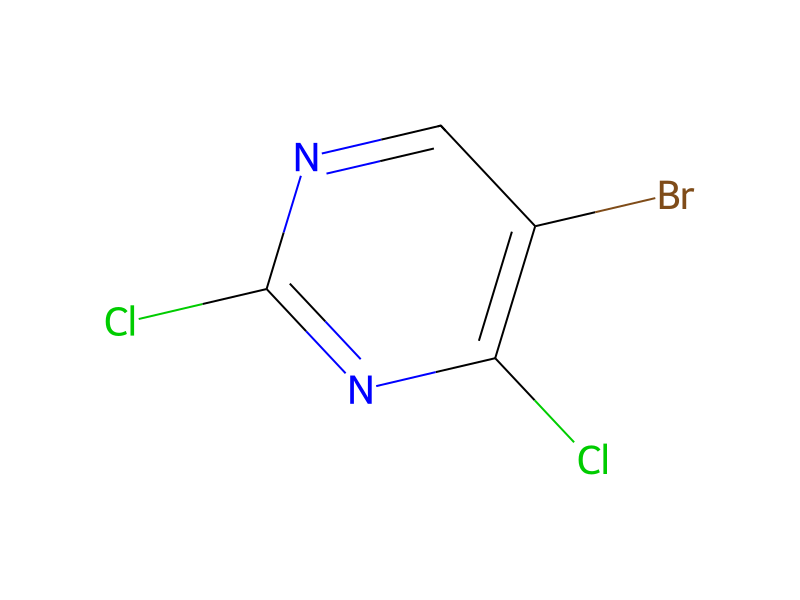
Product 1

Reagents, catalysts & solvents 1

Procedure
A solution of 1.35 g (15.0 mmol) of (R,R)-(−)-2,3-butanediol in 50 ml of THF is mixed at 0° C. in portions with 480 mg (11.0 mmol) of sodium hydride (55% dispersion) and then stirred for 10 minutes at room temperature. The solution that is produced is added at 0° C. to 2.27 g (10.0 mmol) of 5-bromo-2,4-dichloropyrimidine in 25 ml of THF. The batch is slowly heated to room temperature and stirred for 12 hours. The solvent is drawn off, and the residue that is obtained is purified by chromatography (hexane/ethyl acetate 1:1). 2.29 g (8.1 mmol, corresponding to 81% of theory) of the product is obtained.
Workup
- customThe solution that is produced
- temperatureThe batch is slowly heated to room temperature
- stirringstirred for 12 hours
- customthe residue that is obtained
- customis purified by chromatography (hexane/ethyl acetate 1:1)
- custom2.29 g (8.1 mmol, corresponding to 81% of theory) of the product is obtained
Sources & evidence
- ORD record
- ord-0a3c2040e8f84b3ea58cd9a24429ffc7
- Source dataset
- uspto-grants-2008_03
- Patent number
- US07338958B2
Reaction notes
Loading…