2,6-Lutidine → tert-butyl 3-(2,5-difluorophenyl)-2,3-dihydro-1H-pyrrole-1-carboxylate
Reaction equation

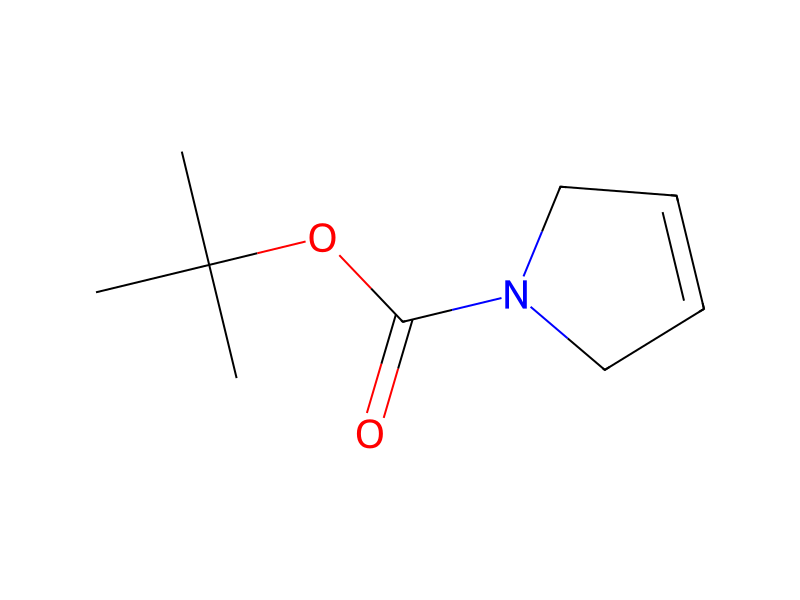
[N:1]1([C:6]([O:8][C:9]([CH3:12])([CH3:11])[CH3:10])=[O:7])[CH2:5][CH:4]=[CH:3][CH2:2]1.F[B-](F)(F)F.[F:18][C:19]1[CH:24]=[CH:23][C:22]([F:25])=[CH:21][C:20]=1[N+]#N.N1C(C)=CC=CC=1C.FC(F)(F)C(OC(=O)C(F)(F)F)=O>O.C(Cl)(Cl)(Cl)Cl.C1(C)C=CC=CC=1.C([O-])(=O)C.[Pd+2].C([O-])(=O)C>[F:18][C:19]1[CH:24]=[CH:23][C:22]([F:25])=[CH:21][C:20]=1[CH:3]1[CH:4]=[CH:5][N:1]([C:6]([O:8][C:9]([CH3:12])([CH3:11])[CH3:10])=[O:7])[CH2:2]1Participants
Reactant 4



Product 1

Reagents, catalysts & solvents 4




Conditions
- Temperature
- 10 °C
Procedure
Palladium(II) acetate (67 mg, 0.30 mmol, 0.020 equiv) was added to a vigorously stirred, deoxygenated mixture of tert-butyl 2,5-dihydro-1H-pyrrole-1-carboxylate (2.59 mL, 15.0 mmol, 1 equiv) and 2,5-difluorobenzenediazonium tetrafluoroborate (2-1, 3.42 g, 15.0 mmol, 1.00 equiv) in water and carbon tetrachloride (1:1, 150 mL) at 23° C., and the resulting mixture was stirred for 20 hours. The reaction mixture was concentrated, and the residue partitioned between ethyl acetate (300 mL) and saturated aqueous sodium bicarbonate solution (75 mL). The organic layer was washed with brine, then dried over sodium sulfate and concentrated. The residue was dissolved in toluene (200 mL), and the resulting solution concentrated in vacuo to facilitate azeotropic removal of residual water. 2,6-Lutidine (3.50 mL, 30.0 mmol, 2.00 equiv) and trifluoroacetic anhydride (1.48 mL, 10.5 mmol, 0.700 equiv) were then sequentially added to a solution of the residue in toluene (100 mL) at −10° C. The resulting mixture was allowed to warm to 10° C. over 16 hours, then heated at reflux for 1 hour. The reaction mixture was allowed to cool to 23° C., then concentrated. The residue was partitioned between ethyl acetate (300 mL) and saturated aqueous sodium bicarbonate solution (150 mL). The organic layer was dried over sodium sulfate and concentrated. The residue was purified by flash column chromatography (hexanes initially, grading to 20% EtOAc in hexanes) to give tert-butyl 3-(2,5-difluorophenyl)-2,3-dihydro-1H-pyrrole-1-carboxylate (2-2) as a red oil. 1H NMR (500 MHz, CDCl3) major rotamer: δ 7.03-6.84 (m, 3H), 6.70 (br s, 1H), 5.01 (br s, 1H), 4.42 (m, 1H), 4.13 (m, 1H), 3.60 (m, 1H), 1.50 (s, 9H).
Workup
- customdeoxygenated
- stirringthe resulting mixture was stirred for 20 hours
- concentrationThe reaction mixture was concentrated
- customthe residue partitioned between ethyl acetate (300 mL) and saturated aqueous sodium bicarbonate solution (75 mL)
- washThe organic layer was washed with brine
- dry with materialdried over sodium sulfate
- concentrationconcentrated
- dissolutionThe residue was dissolved in toluene (200 mL)
- concentrationthe resulting solution concentrated in vacuo
- customremoval of residual water
- temperatureheated
- temperatureat reflux for 1 hour
- temperatureto cool to 23° C.
- concentrationconcentrated
- customThe residue was partitioned between ethyl acetate (300 mL) and saturated aqueous sodium bicarbonate solution (150 mL)
- dry with materialThe organic layer was dried over sodium sulfate
- concentrationconcentrated
- customThe residue was purified by flash column chromatography (hexanes initially
Sources & evidence
- ORD record
- ord-a389be665663462293bcbc9de4376831
- Source dataset
- uspto-grants-2008_03
- Patent number
- US07348440B2
Reaction notes
Loading…