4-Methylmorpholine → HCID 25107210, compound
Reaction equation

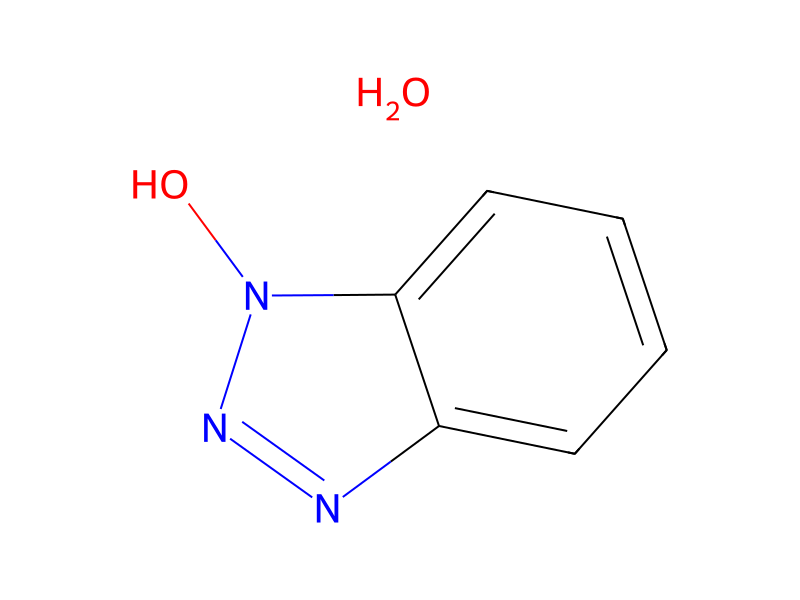
[NH2:1][C:2]1[CH:7]=[CH:6][C:5]([C:8]2[S:12][C:11]([C:13]3([O:17][CH2:18][C:19]([O:21]C)=[O:20])[CH2:16][CH2:15][CH2:14]3)=[N:10][CH:9]=2)=[CH:4][CH:3]=1.[CH:23]1([C:31](O)=[O:32])[C:26]2[CH:27]=[CH:28][CH:29]=[CH:30][C:25]=2[CH2:24]1.CN1CCOCC1.O.ON1C2C=CC=CC=2N=N1.Cl.C(N=C=NCCCN(C)C)C>CN(C)C=O>[C:25]12[CH2:24][CH:23]([C:31]([NH:1][C:2]3[CH:7]=[CH:6][C:5]([C:8]4[S:12][C:11]([C:13]5([O:17][CH2:18][C:19]([OH:21])=[O:20])[CH2:16][CH2:15][CH2:14]5)=[N:10][CH:9]=4)=[CH:4][CH:3]=3)=[O:32])[C:26]1=[CH:27][CH:28]=[CH:29][CH:30]=2Participants
Reactant 5




Product 1

Reagents, catalysts & solvents 1

Conditions
- Temperature
- 50 °C
Procedure
To a solution of Example 24B (0.150 g, 0.470 mmol), 1,2-dihydrocyclobutabenzene-1-carboxylic acid (0.070 g, 0.470 mmol), N-methylmorpholine (0.103 mL, 0.940 mmol), and 1-hydroxybenzotriazole hydrate (0.080 g, 0.940 mmol) in N,N-dimethylformamide-(2 mL) was added 1-ethyl-3-[3-(dimethylamino)propyl]-carbodiimide hydrochloride (0.115 g, 0.589 mmol). The solution was heated to 50° C. for 3 h, cooled to room temperature, and partitioned between H2O (2 mL) and ethyl acetate (2 mL). The layers were separated, and the aqueous was extracted with additional ethyl acetate (2×2 mL). The combined organics were dried with anhydrous Na2SO4, filtered, and concentrated under reduced pressure. The residue was dissolved in methanol (5 mL) and 2 N NaOH (0.50 mL) was added. After 5 h, the methanol was removed under reduced pressure. The aqueous was acidified with 10% HCl to pH 1. The solid was filtered and air-dried. Purification of the residue by RP-HPLC (preparative reversed-phase high pressure liquid chromatography) using a Zorbax SB-C18 7M 21.2×250 mm column with UV detection analyzed at 220 and 254 nM (preparative method: water with 0.1% trifluoroacetic acid and CH3CN with 0.1% trifluoroacetic acid gradient 5-95% CH3CN over 30 minutes at 15 mL/min) provided the title compound as a white solid. 1H NMR (300 MHz, DMSO-d6) δ ppm 1.67-1.94 (m, 2 H), 2.39-2.47 (m, 4 H), 3.31-3.40 (m, 2 H), 3.93 (s, 2 H) 4.44 (dd, J=4.9 and 2.9 Hz, 1 H), 7.09-7.31 (m, 4 H), 7.56-7.68 (m, 2 H), 7.67-7.78 (m, 2 H), 8.07 (s, 1 H), 10.37 (s, 1 H); MS (ESI) m/z 435 [M+H]+.
Workup
- temperaturecooled to room temperature
- custompartitioned between H2O (2 mL) and ethyl acetate (2 mL)
- customThe layers were separated
- extractionthe aqueous was extracted with additional ethyl acetate (2×2 mL)
- dry with materialThe combined organics were dried with anhydrous Na2SO4
- filtrationfiltered
- concentrationconcentrated under reduced pressure
- dissolutionThe residue was dissolved in methanol (5 mL)
- addition2 N NaOH (0.50 mL) was added
- customthe methanol was removed under reduced pressure
- filtrationThe solid was filtered
- customair-dried
- customPurification of the residue by RP-HPLC (preparative reversed-phase high pressure liquid chromatography)
- customanalyzed at 220 and 254 nM (preparative method: water with 0.1% trifluoroacetic acid and CH3CN with 0.1% trifluoroacetic acid gradient 5-95% CH3CN over 30 minutes at 15 mL/min)
Sources & evidence
- ORD record
- ord-7ba535a4ea534215b8e55edfeafc5553
- Source dataset
- uspto-grants-2014_12
- Patent number
- US08901152B2
Reaction notes
Loading…