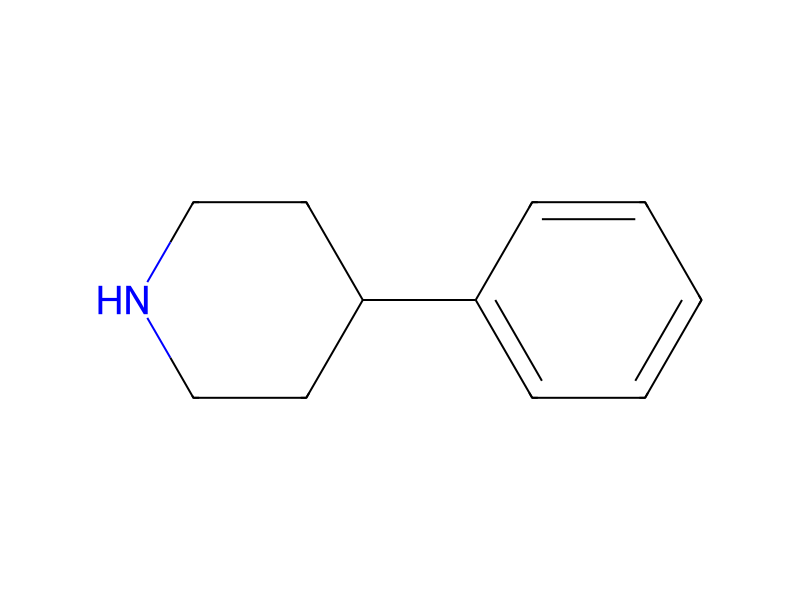
4-Phenylpiperidine → HCID 67042349, compound
Reaction equation

Br[C:2]1[C:3]([C:16]2[CH:21]=[CH:20][CH:19]=[CH:18][CH:17]=2)=[N:4][C:5]2[C:10]([N:11]=1)=[CH:9][C:8]([C:12]([O:14][CH3:15])=[O:13])=[CH:7][CH:6]=2.[C:22]1([CH:28]2[CH2:33][CH2:32][NH:31][CH2:30][CH2:29]2)[CH:27]=[CH:26][CH:25]=[CH:24][CH:23]=1.CCN(C(C)C)C(C)C>CN(C)C=O>[C:16]1([C:3]2[C:2]([N:31]3[CH2:32][CH2:33][CH:28]([C:22]4[CH:27]=[CH:26][CH:25]=[CH:24][CH:23]=4)[CH2:29][CH2:30]3)=[N:11][C:10]3[C:5](=[CH:6][CH:7]=[C:8]([C:12]([O:14][CH3:15])=[O:13])[CH:9]=3)[N:4]=2)[CH:21]=[CH:20][CH:19]=[CH:18][CH:17]=1Participants
5
Reactant 3


Product 1

Reagents, catalysts & solvents 1

Conditions
- Temperature
- 100 °C
Procedure
Into a 8-mL sealed tube, was placed methyl 3-bromo-2-phenylquinoxaline-6-carboxylate (150 mg, 0.44 mmol, 1.00 equiv), 4-phenylpiperidine (141.68 mg, 0.88 mmol, 2.00 equiv), DIEA (170.3 mg, 1.32 mmol, 3.00 equiv), N,N-dimethylformamide (4 mL). The resulting solution was stirred overnight at 100° C. in an oil bath. The resulting mixture was concentrated under vacuum. The residue was applied onto a silica gel column with PE/EA (100:1). This resulted in 92.9 mg (49%) of methyl 2-phenyl-3-(4-phenylpiperidin-1-yl)quinoxaline-6-carboxylate as a yellow solid.
Workup
- customInto a 8-mL sealed tube
- concentrationThe resulting mixture was concentrated under vacuum
- customThis resulted in 92.9 mg (49%) of methyl 2-phenyl-3-(4-phenylpiperidin-1-yl)quinoxaline-6-carboxylate as a yellow solid
Sources & evidence
- ORD record
- ord-dad8524d33604427a9bdc68d16c03ff3
- Source dataset
- uspto-grants-2014_12
- Patent number
- US08916560B2
Reaction notes
Loading…