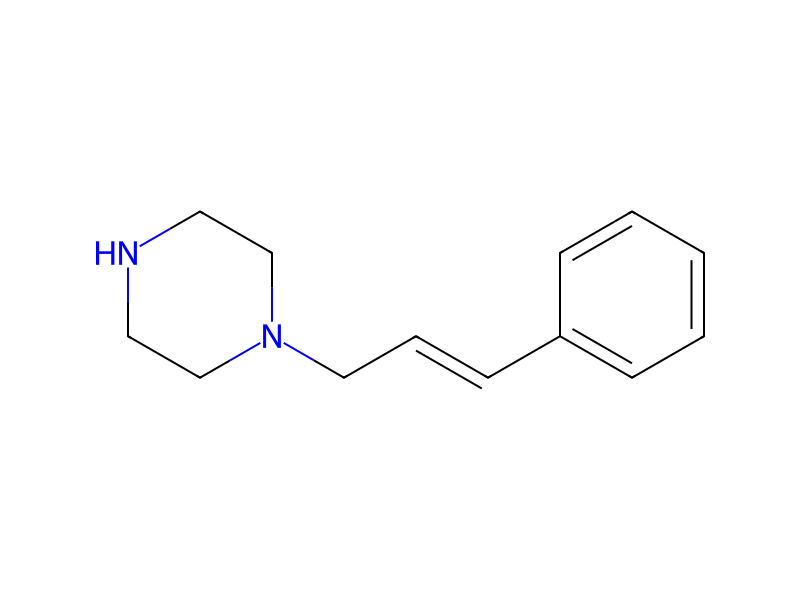
Piperazine → Cinnamylpiperazine
Reaction equation

[NH:1]1[CH2:6][CH2:5][NH:4][CH2:3][CH2:2]1.[CH2:7](Cl)[CH:8]=[CH:9][C:10]1[CH:15]=[CH:14][CH:13]=[CH:12][CH:11]=1>C(O)(C)C>[CH2:7]([N:1]1[CH2:6][CH2:5][NH:4][CH2:3][CH2:2]1)[CH:8]=[CH:9][C:10]1[CH:15]=[CH:14][CH:13]=[CH:12][CH:11]=1Participants
Reactant 2


Product 1
Reagents, catalysts & solvents 1

Conditions
- Temperature
- 70 °C
Procedure
Absolute piperazine (217 g, 2.5 moles) was dissolved in 1 liter of isopropanol and 72.6 g of cinnamyl chloride (0.5 moles) were added dropwise gradually at room temperature without mixing. After the completion of dropwise addition, it was heated at 70° C for 3 hrs. with mixing. After the solvent was distilled away, the reaction mixture was dissolved in 500 ml of chloroform and then washed with sodium hydroxide and water. Subsequently, it was dried over potassium carbonate and then was filtered. Chloroform was distilled away in vacuo. By Subliming the mixture obtained, piperazine was removed and then the residues were distiled to obtain N-cinnamyl piperazine. The product was crystallized and then was recrystallized from n-hexane. Boiling point of the product was 162°-165° C (4 mmHg). Melting point was 31°-33° C and the yield was 56%.
Workup
- additionwithout mixing
- additionAfter the completion of dropwise addition, it
- additionwith mixing
- distillationAfter the solvent was distilled away
- dissolutionthe reaction mixture was dissolved in 500 ml of chloroform
- washwashed with sodium hydroxide and water
- dry with materialSubsequently, it was dried over potassium carbonate
- filtrationwas filtered
- distillationChloroform was distilled away in vacuo
- customobtained
- custompiperazine was removed
- customthe residues were distiled
Sources & evidence
- ORD record
- ord-73ef7e8db841494dad3fe95a14672bb2
- Source dataset
- uspto-grants-1977_01
- Patent number
- US04001223
Reaction notes
Loading…