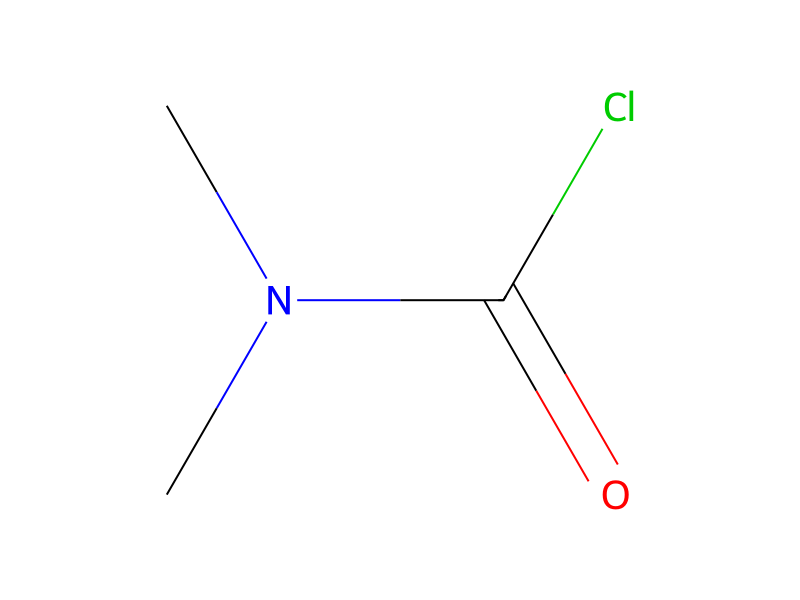
Dimethylcarbamoyl Chloride → 1-Piperidinecarboxamide, 3-amino-N,N-dimethyl-
Reaction equation

C1(=O)N(C2CCCNC2)C(=O)C2=CC=CC=C12.CN(C)C(Cl)=O.[CH3:24][N:25]([CH3:45])[C:26]([N:28]1[CH2:33][CH2:32][CH2:31][CH:30]([N:34]2C(=O)C3=CC=CC=C3C2=O)[CH2:29]1)=[O:27].O.NN>>[CH3:24][N:25]([CH3:45])[C:26]([N:28]1[CH2:33][CH2:32][CH2:31][CH:30]([NH2:34])[CH2:29]1)=[O:27]Participants
5



Procedure
In addition, reacting 3-phthalimidopiperidine with N,N-dimethylcarbamoyl chloride and treating the resulting 1-(N,N-dimethylcarbamoyl)-3-phthalimidopiperidine with hydrazine hydrate gives 1-(N,N-dimethylcarbamoyl)-3-aminopiperidine. Reacting this piperidine compound with 9-acetoxyxanthene by the procedure of Example 1 gives N-[1-(N,N-dimethylcarbamoyl)-3-piperidinyl]-9-xanthenylamine.
Sources & evidence
- ORD record
- ord-1d273901cc1440d693e28e2ab4c0e80c
- Source dataset
- uspto-grants-1977_01
- Patent number
- US04005208
Reaction notes
Loading…