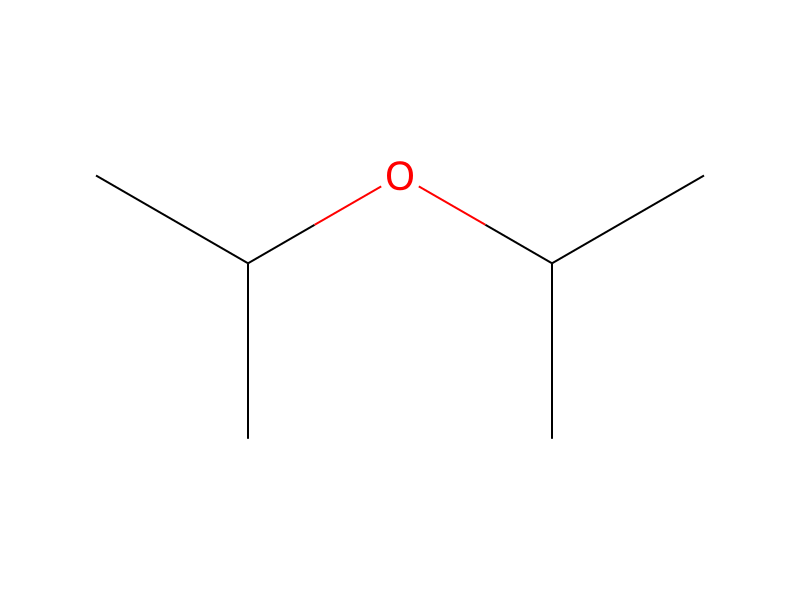
Ethanol → Diisopropyl Ether
Reaction equation

C([NH:8][C@H:9]([C:13]([OH:15])=O)[CH:10]([CH3:12])[CH3:11])(O[C:4](C)([CH3:6])[CH3:5])=O.[CH3:16]N1CCOCC1.ClC(OCC(C)C)=O.[NH2:31][C@H:32]1[CH2:36][CH2:35][N:34]([C:37]2[N:46]=[C:45]3[C:40]([C:41](=[O:63])[C:42]([C:58]([O:60]CC)=[O:59])=[CH:43][N:44]3[C:47]3[CH:52]=[C:51]([NH:53]C=O)[C:50]([F:56])=[CH:49][C:48]=3[F:57])=[CH:39][C:38]=2[F:64])[CH2:33]1.[CH2:65]([OH:67])[CH3:66]>ClCCl.O.C(Cl)(Cl)Cl>[CH:65]([O:67][CH:4]([CH3:6])[CH3:5])([CH3:16])[CH3:66].[NH2:53][C:51]1[CH:52]=[C:47]([N:44]2[C:45]3[C:40](=[CH:39][C:38]([F:64])=[C:37]([N:34]4[CH2:35][CH2:36][C@H:32]([NH:31][C:13](=[O:15])[C@H:9]([CH:10]([CH3:11])[CH3:12])[NH2:8])[CH2:33]4)[N:46]=3)[C:41](=[O:63])[C:42]([C:58]([OH:60])=[O:59])=[CH:43]2)[C:48]([F:57])=[CH:49][C:50]=1[F:56]Participants
Reactant 5




Product 2

Reagents, catalysts & solvents 3



Conditions
- Temperature
- -20 °C
Procedure
To 5 ml of dichloromethane were added 220 mg of N-Boc-L-valine and 106 mg of N-methylmorpholine. With stirring at -20° C., 140 μl of isobutyl chloroformate was added to the solution, which was stirred for 20 minutes. This solution was cooled to -60° C., and a dispersion of 475 mg of ethyl 7-[(3S)-3-aminopyrrolidin-1-yl]-1-(2,4-difluoro-5-formylaminophenyl)-6-fluoro-4-oxo-1,4-dihydro-1,8-naphthyridine-3-carboxylate in 10 ml of dichloromethane was added thereto. The solution was allowed to slowly warm up to room temperature and then stirred at 40° C. for 30 minutes. To the solution was added 20 ml of chloroform and 10 ml of distilled water. The solution was separated, dried over anhydrous magnesium sulfate, and concentrated in vacua. A half fraction of the bubbly solidified residue was dissolved in a mixture of 3 ml of 1N hydrochloric acid and 3 ml of ethanol, and the solution was stirred at 100° C. for 1.5 hours. The solution was concentrated in vacua, 3 ml of 1N hydrochloric acid was added to the residue, and the solution was stirred at 100° C. for 40 minutes. The solution was concentrated in vacua and the residue was dissolved in 2 ml of distilled water. The solution was neutralized to about pH 8 by adding a 10% sodium hydroxide aqueous solution little by little, causing a precipitate to form. With 2 ml of ethanol added, the solution was heated at reflux for 30 minutes and allowed to stand. The precipitate was collected by filtration, and washed with ethanol and then diisopropyl ether to give 141 mg of the title compound.
Workup
- stirringwas stirred for 20 minutes
- temperatureThis solution was cooled to -60° C.
- temperatureto slowly warm up to room temperature
- stirringstirred at 40° C. for 30 minutes
- customThe solution was separated
- dry with materialdried over anhydrous magnesium sulfate
- concentrationconcentrated in vacua
- dissolutionA half fraction of the bubbly solidified residue was dissolved in a mixture of 3 ml of 1N hydrochloric acid and 3 ml of ethanol
- stirringthe solution was stirred at 100° C. for 1.5 hours
- concentrationThe solution was concentrated in vacua, 3 ml of 1N hydrochloric acid
- additionwas added to the residue
- stirringthe solution was stirred at 100° C. for 40 minutes
- concentrationThe solution was concentrated in vacua
- dissolutionthe residue was dissolved in 2 ml of distilled water
- additionby adding a 10% sodium hydroxide aqueous solution little by little,
- customto form
- temperaturethe solution was heated
- temperatureat reflux for 30 minutes
- filtrationThe precipitate was collected by filtration
- washwashed with ethanol
Sources & evidence
- ORD record
- ord-8583e0b83c154410a215d47510cb925e
- Source dataset
- uspto-grants-1999_06
- Patent number
- US05910498
Reaction notes
Loading…