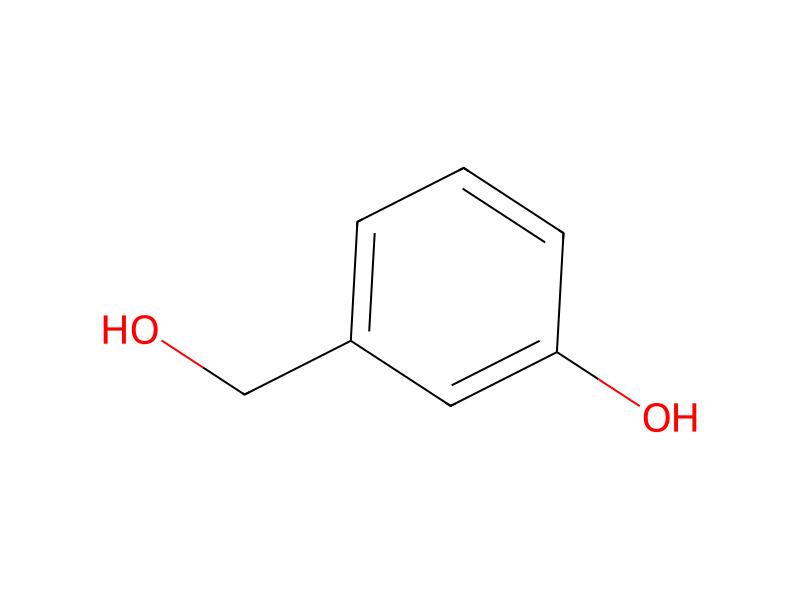
3-Hydroxybenzyl alcohol → 3-(2-Quinazolinylmethoxy)benzyl alcohol
Reaction equation

Cl[CH2:2][C:3]1[N:12]=[CH:11][C:10]2[C:5](=[CH:6][CH:7]=[CH:8][CH:9]=2)[N:4]=1.C([O-])([O-])=O.[K+].[K+].[OH:19][C:20]1[CH:21]=[C:22]([CH:25]=[CH:26][CH:27]=1)[CH2:23][OH:24]>CN(C=O)C.[Br-].C([N+](CCCC)(CCCC)CCCC)CCC>[N:4]1[C:5]2[C:10](=[CH:9][CH:8]=[CH:7][CH:6]=2)[CH:11]=[N:12][C:3]=1[CH2:2][O:19][C:20]1[CH:21]=[C:22]([CH:25]=[CH:26][CH:27]=1)[CH2:23][OH:24]Participants
6





Procedure
To a solution of 5.00 g (28 mmol) of 2-chloromethylquinazoline in 50 ml of DMF, 4.26 g (31 mmol) of K2CO3 and 903 mg (2.8 mmol) of tetra-n-butylammonium bromide were added. 3-Hydroxybenzyl alcohol (3.48 g, 28 mmol) was added further, followed by stirring at room temperature for 5 days. The reaction mixture was concentrated under reduced pressure, followed by the addition of CHCl3 and water to extract the reaction product into the organic layer. The extract was dried over Na2SO4 and then concentrated under reduced pressure. The residue was recrystallized from a CHCl3 -n-hexane mixed solvent, whereby 6.4 g of the title compound was obtained as pale yellow powder (yield: 93.1%).
Workup
- concentrationThe reaction mixture was concentrated under reduced pressure
- additionfollowed by the addition of CHCl3 and water
- extractionto extract the reaction product into the organic layer
- dry with materialThe extract was dried over Na2SO4
- concentrationconcentrated under reduced pressure
- customThe residue was recrystallized from a CHCl3 -n-hexane mixed solvent
Sources & evidence
- ORD record
- ord-35f1e9da5ff94e44b5bd28726894b8ce
- Source dataset
- uspto-grants-1999_03
- Patent number
- US05885987
Reaction notes
Loading…