Hydrochloric Acid → 2-(2-Methoxyethoxy)ethyl 4-hydroxybenzoate
Reaction equation

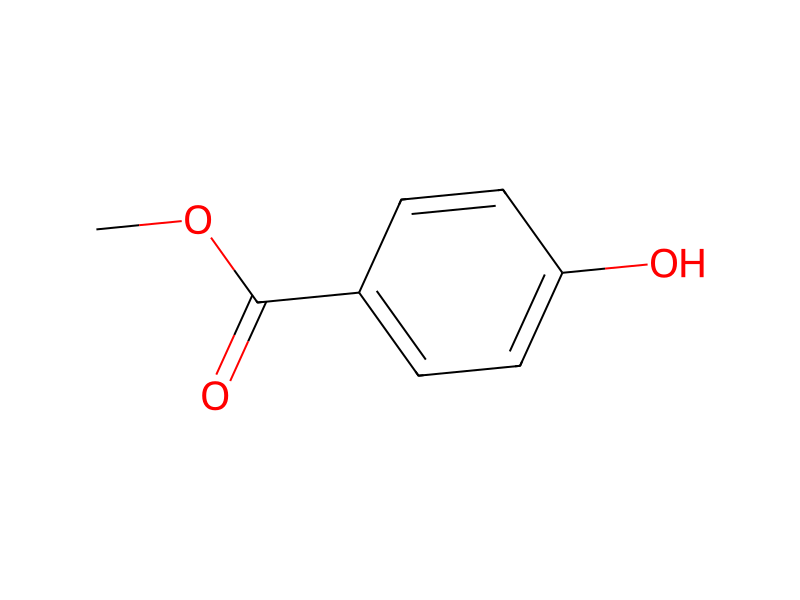
[Na].[OH:2][C:3]1[CH:12]=[CH:11][C:6]([C:7]([O:9][CH3:10])=[O:8])=[CH:5][CH:4]=1.Cl.[CH3:14][O:15][CH2:16][CH2:17][O:18][CH2:19]CO>>[OH:2][C:3]1[CH:4]=[CH:5][C:6]([C:7]([O:9][CH2:10][CH2:14][O:15][CH2:16][CH2:17][O:18][CH3:19])=[O:8])=[CH:11][CH:12]=1Participants
5




Conditions
- Temperature
- 130 °C
Procedure
In a first step, an amount of 1 g (43 mmol) of sodium was dissolved in 25 of ml 2-(2-methoxyethoxy)ethanol. To the resulted solution an amount of 3 g (22 mmol) of methyl 4-hydroxybenzoate was added and the mixture was heated to 130° C. for 24 hours; after cooling to room temperature, it was acidified with a hydrochloric acid solution (3N) and extracted with ethyl acetate. The removal of the solvent under reduced pressure and column chromatography of the residue (silica gel, hexane:ethyl acetate 3:1) afforded 2-(2-methoxyethoxy)ethyl 4-hydroxybenzoate, in the form of a colourless oil in essentially quantitative yield.
Workup
- temperatureafter cooling to room temperature
- extractionextracted with ethyl acetate
- customThe removal of the solvent under reduced pressure and column chromatography of the residue (silica gel, hexane:ethyl acetate 3:1)
Sources & evidence
- ORD record
- ord-2de1a41887514c1786b64dfc86c398a8
- Source dataset
- uspto-grants-1996_03
- Patent number
- US05496854
Reaction notes
Loading…