Potassium Carbonate → Potassium Clavulanate
Reaction equation

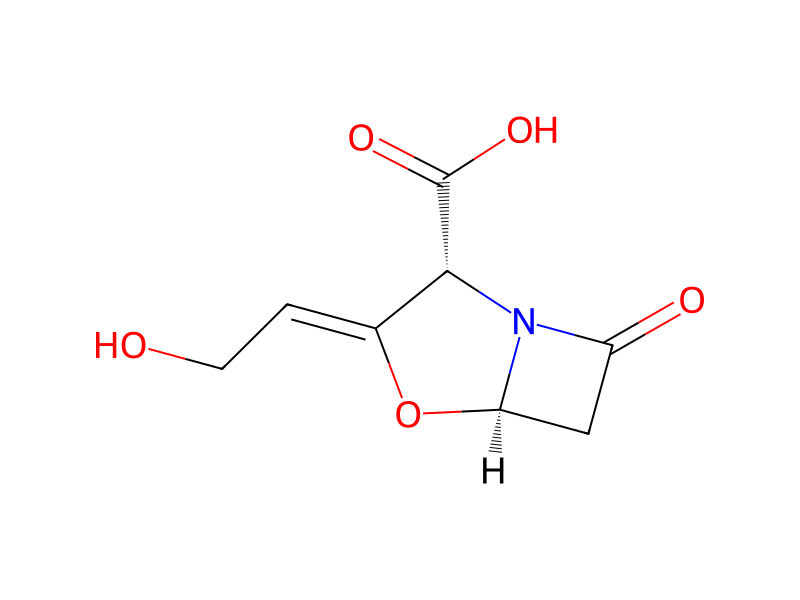
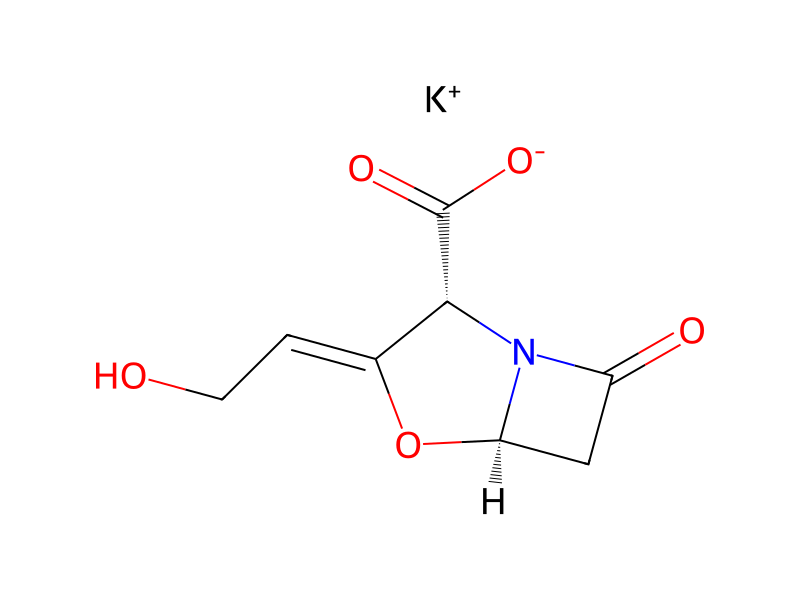
[CH2:1]1[C:4](=[O:5])[N:3]2[C@@H:6]([C:12]([OH:14])=[O:13])/[C:7](/[O:11][C@H:2]12)=[CH:8]/[CH2:9][OH:10].C(=O)([O-])[O-].[K+:19].[K+]>>[CH2:1]1[C:4](=[O:5])[N:3]2[C@@H:6]([C:12]([O-:14])=[O:13])/[C:7](/[O:11][C@H:2]12)=[CH:8]/[CH2:9][OH:10].[K+:19]Participants
3

Procedure
The inclusion complex (100 g) of clavulanic acid with heptakis-(2,3,6-tri-O-acetyl)-β-CD, which was prepared in the same way as in Example 4, was suspended in a 3% aqueous potassium carbonate solution (200 ml), in which methyl-β-CD (53.6 g, 40.9 mmol) was dissolved. The suspension was stirred for 5 min at ambient temperature, the solid particles were filtered off and the filtrate was frozen in liquid nitrogen and then freeze-dried. There was obtained a yellowish microcrystalline inclusion complex (56.7 g, 91.9%) of potassium clavulanate with methyl-β-CD. The complex contained 14.9% of potassium clavulanate as it was determined by the HPLC method.
Workup
- dissolutionwas dissolved
- filtrationthe solid particles were filtered off
- temperaturethe filtrate was frozen in liquid nitrogen
- customfreeze-dried
Sources & evidence
- ORD record
- ord-420793dbd18342e6a9e379a92fdc8f4d
- Source dataset
- uspto-grants-1996_03
- Patent number
- US05498788
Reaction notes
Loading…