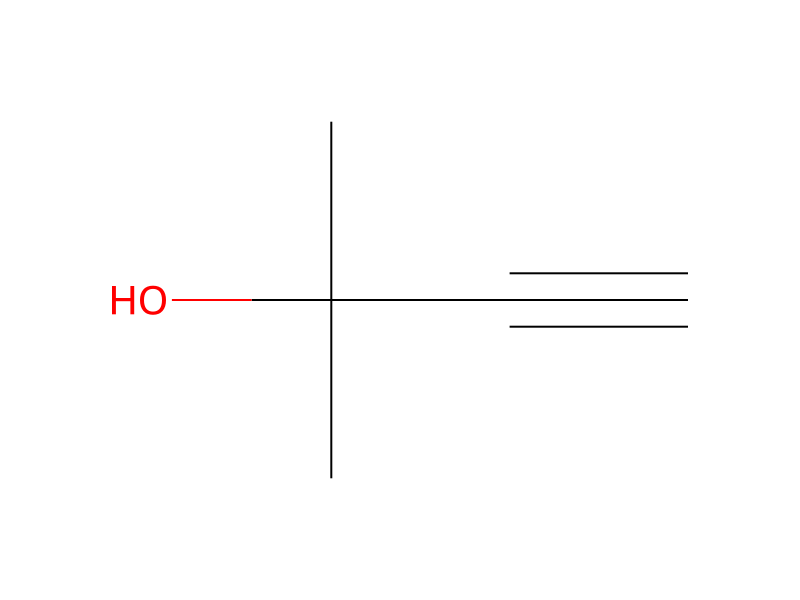
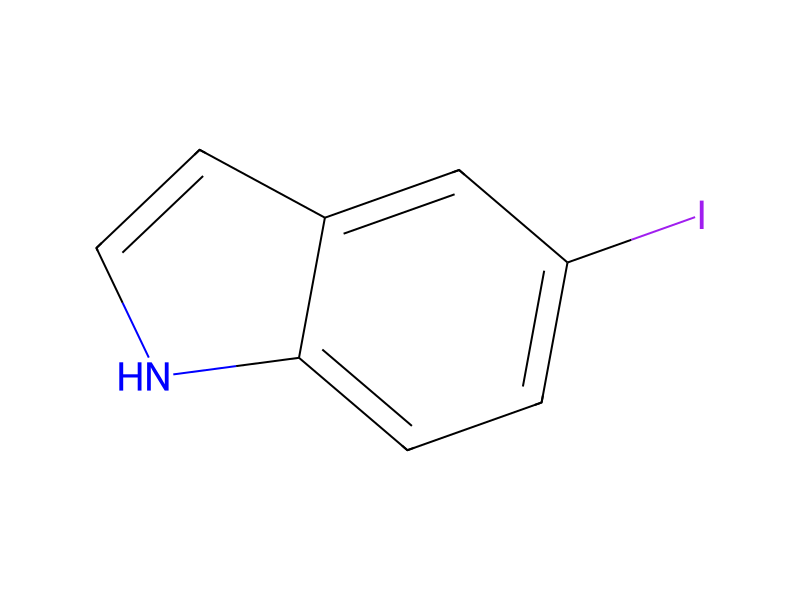
2-Methyl-3-butyn-2-ol → 4-(1H-indol-5-yl)-2-methyl-but-3-yn-2-ol
Reaction equation

I[C:2]1[CH:3]=[C:4]2[C:8](=[CH:9][CH:10]=1)[NH:7][CH:6]=[CH:5]2.C1(P(C2C=CC=CC=2)C2C=CC=CC=2)C=CC=CC=1.C(=O)([O-])[O-].[K+].[K+].[CH3:36][C:37]([OH:41])([C:39]#[CH:40])[CH3:38]>[Cu]I.[Pd].COCCOC>[NH:7]1[C:8]2[C:4](=[CH:3][C:2]([C:40]#[C:39][C:37]([CH3:38])([OH:41])[CH3:36])=[CH:10][CH:9]=2)[CH:5]=[CH:6]1Participants
Reactant 4


Product 1

Reagents, catalysts & solvents 3



Procedure
A mixture of 5-iodoindole (25 g, 102.9 mmol), triphenylphosphine (2.70 g, 10.3 mmol), CuI (1.96 g, 10.3 mmol), potassium carbonate (35.5 g, 257.2 mmol), palladium (5 wt. % on calcium carbonate, poisoned with lead) (0.55 g, 5.14 mmol) and 1,2-dimethoxyethane (250 ml) was stirred at room temperature for 0.5 hour. 2-Methyl-3-butyn-2-ol (21.6 g, 257 mmol) was added and the mixture was stirred for 15 hours at 100° C. The crude mixture was filtered through silica gel and aqueous hydrochloric acid (250 ml, 2 M) was added and extracted with toluene. The organic phase was dried and evaporated. Chromatography on silica gel with dichloromethane, 10% methanol and 1% aqueous ammonia as solvent gave the title compound. Yield 6.7 g (33%). Mp. 119-123° C.
Workup
- stirringthe mixture was stirred for 15 hours at 100° C
- filtrationThe crude mixture was filtered through silica gel and aqueous hydrochloric acid (250 ml, 2 M)
- additionwas added
- extractionextracted with toluene
- customThe organic phase was dried
- customevaporated
Sources & evidence
- ORD record
- ord-f29690ea37364b2d9a3452c77918c547
- Source dataset
- uspto-grants-2010_02
- Patent number
- US07662812B2
Reaction notes
Loading…