2,5-Dichloronitrobenzene → HCID 19377564, compound
Reaction equation

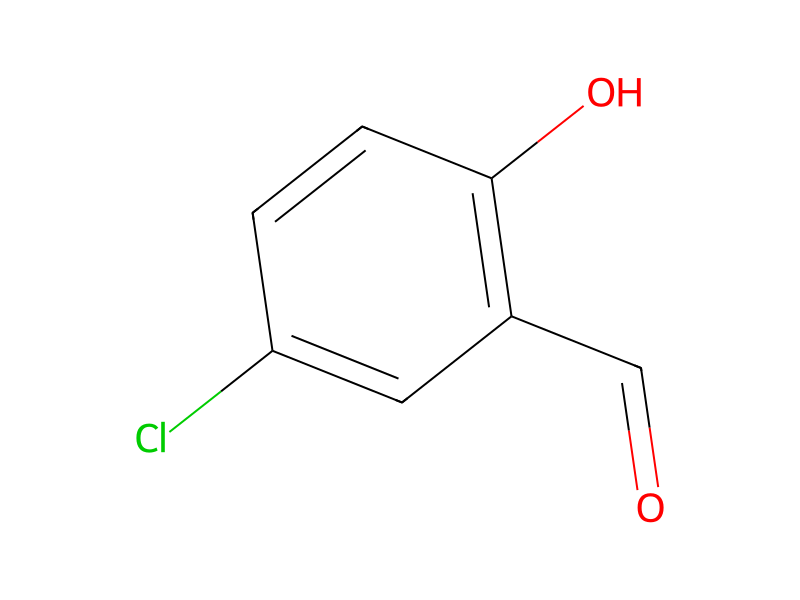
[Cl:1][C:2]1[CH:9]=[C:6]([CH:7]=[O:8])[C:5]([OH:10])=[CH:4][CH:3]=1.[H-].[Na+].Cl[C:14]1[CH:19]=[CH:18][C:17]([Cl:20])=[CH:16][C:15]=1[N+:21]([O-:23])=[O:22]>CN(C)C=O>[Cl:1][C:2]1[CH:3]=[CH:4][C:5]([O:10][C:14]2[CH:19]=[CH:18][C:17]([Cl:20])=[CH:16][C:15]=2[N+:21]([O-:23])=[O:22])=[C:6]([CH:9]=1)[CH:7]=[O:8]Participants
Reactant 3


Product 1

Reagents, catalysts & solvents 1

Conditions
- Temperature
- 100 °C
Procedure
To a stirred solution of 5-chlorosalicylaldehyde (8.56 g) in N,N-dimethylformamide (90 mL) under nitrogen was added, in portions, sodium hydride (1.37 g). To the resulting solution was added 2,5-dichloro-1-nitrobenzene (10.0 g) and N,N-dimethylformamide (10 mL), and the reaction was heated at 100° C. under nitrogen for 6 hours. The reaction was evaporated under vacuum, and the residue was partitioned between chloroform and 1 N NaOH. The layers were separated, and the aqueous layer was extracted once more with chloroform. The combined chloroform extracts were washed with 1 N NaOH, water, 1 N HCl, water, and brine, dried over magnesium sulfate, and evaporated under vacuum. Crystallization from methanol yielded the title compound as a yellow solid. Mp: 128°-130° C.
Workup
- customThe reaction was evaporated under vacuum
- customthe residue was partitioned between chloroform and 1 N NaOH
- customThe layers were separated
- extractionthe aqueous layer was extracted once more with chloroform
- washThe combined chloroform extracts were washed with 1 N NaOH, water, 1 N HCl, water, and brine
- dry with materialdried over magnesium sulfate
- customevaporated under vacuum
- customCrystallization from methanol
Sources & evidence
- ORD record
- ord-a6b75b62daca45edb00134ff94c125a7
- Source dataset
- uspto-grants-1994_04
- Patent number
- US05304644
Reaction notes
Loading…