Potassium Carbonate → HCID 5020942, compound
Reaction equation

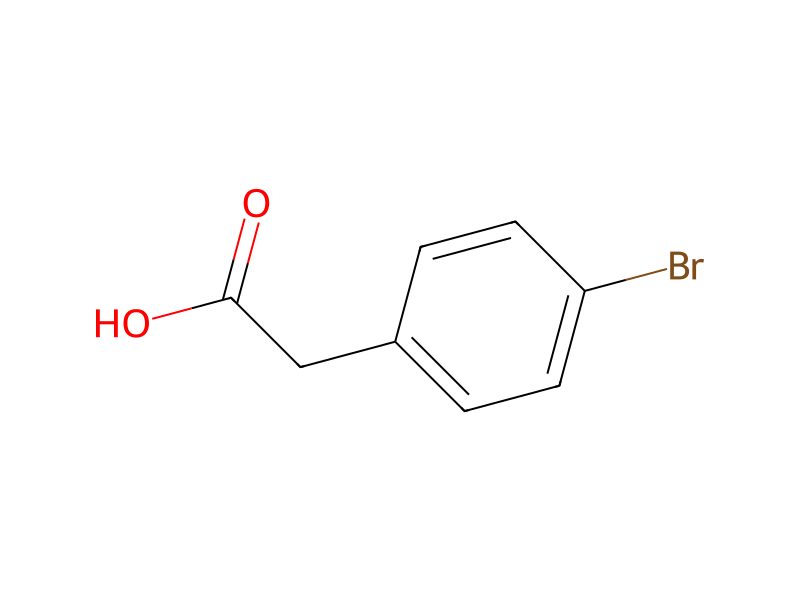
P(Cl)(Cl)(Cl)=O.[Br:6][C:7]1[CH:12]=[CH:11][C:10]([CH2:13][C:14]([OH:16])=O)=[CH:9][CH:8]=1.[C:17]([O-])([O-])=[O:18].[K+].[K+].[OH-].[Na+]>CN(C=O)C>[Br:6][C:7]1[CH:8]=[CH:9][C:10]([C:13](=[CH:14][OH:16])[CH:17]=[O:18])=[CH:11][CH:12]=1Participants
6
Reactant 4



Product 1

Reagents, catalysts & solvents 1

Conditions
- Temperature
- 75 °C
Procedure
Cool to 4° C. phosphorous oxychloride (2.34 mL, 26.0 mmol) in a 100 mL flask. To this, add 5 mL of DMF and stir mixture for 5 min. Remove the flask from the cooling bath and heat at 75° C. Add (4-bromophenyl)acetic acid (2.00 g, 9.30 mmol) in one portion with an additional 5 mL of DMF and stir the mixture at 75° C. under Ar for 16 h. Pour the mixture into ice and neutralize by slow addition of K2CO3. Heat the solution at 75° C. and make strongly basic by the addition of 50% aq. NaOH resulting in an oil. Extract the oil from the aq. phase with 2×70 mL of CH2Cl2, dry with MgSO4, filter and concentrate to give 2.10 g, 99% of 2-(4-bromo-phenyl)-3-hydroxy-propenal.
Workup
- customRemove the flask from the cooling bath
- additionPour the mixture into ice and neutralize
- temperatureHeat the solution at 75° C.
- extractionExtract the oil from the aq. phase with 2×70 mL of CH2Cl2
- dry with materialdry with MgSO4
- filtrationfilter
- concentrationconcentrate
Sources & evidence
- ORD record
- ord-02957d82b4ee4577809f565be6d75b4a
- Source dataset
- uspto-grants-2015_04
- Patent number
- US09000154B2
Reaction notes
Loading…