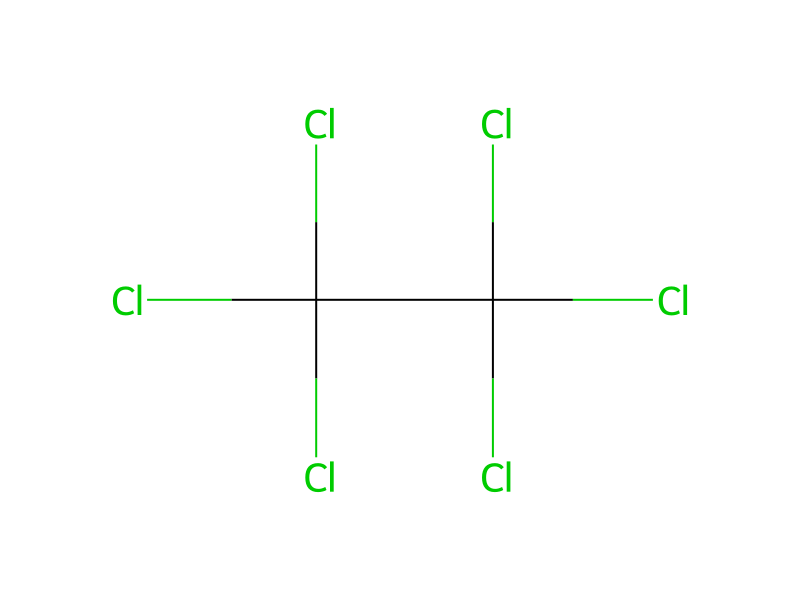
Hexachloroethane → 5-Chloro-2-pyridin-4-yloxazolo[5,4-d]pyrimidine
Reaction equation

C1(P(C2C=CC=CC=2)C2C=CC=CC=2)C=CC=CC=1.C(N(CC)CC)C.ClC(Cl)(Cl)C(Cl)(Cl)Cl.[Cl:35][C:36]1[N:41]=[C:40](O)[C:39]([NH:43][C:44](=[O:51])[C:45]2[CH:50]=[CH:49][N:48]=[CH:47][CH:46]=2)=[CH:38][N:37]=1>ClCCCl>[Cl:35][C:36]1[N:37]=[CH:38][C:39]2[N:43]=[C:44]([C:45]3[CH:46]=[CH:47][N:48]=[CH:49][CH:50]=3)[O:51][C:40]=2[N:41]=1Participants
6





Procedure
12.0 g (35.9 mmol) polymer bound triphenylphosphine and 5.03 mL (35.9 mmol) triethylamine are added to 4.77 g (20.0 mmol) hexachloroethane in 40 mL 1,2-dichloroethane. The mixture is stirred for 5 min at rt. 1.00 g (4.0 mmol) N-(2-chloro-4-hydroxy-pyrimidin-5-yl)-isonicotinamide in 20 mL 1,2-dichloroethane are added and the mixture is stirred for 12 h at rt. Subsequently the mixture is concentrated in vacuo, treated with diethyl ether, filtered, and concentrated again. The residue is purified by HPLC (reversed phase; water (+0.1% TFA)/MeOH) to yield the desired product.
Workup
- stirringthe mixture is stirred for 12 h at rt
- concentrationSubsequently the mixture is concentrated in vacuo
- additiontreated with diethyl ether
- filtrationfiltered
- concentrationconcentrated again
- customThe residue is purified by HPLC (reversed phase; water (+0.1% TFA)/MeOH)
Sources & evidence
- ORD record
- ord-e8eaa5c9af524868b30ff55e39e85193
- Source dataset
- uspto-grants-2015_04
- Patent number
- US09006450B2
Reaction notes
Loading…