Methanol → Trifluoroacetic acid
Reaction equation

CN([C:4]([O:8]N1N=NC2C=CC=NC1=2)=[N+:5](C)C)C.F[P-](F)(F)(F)(F)F.[C:25]([OH:31])([C:27]([F:30])([F:29])[F:28])=[O:26].[NH:32]1[CH2:36][CH2:35][CH2:34][C@H:33]1[C:37]1[NH:41][C:40]2[CH:42]=[C:43]([C:46]3[CH:55]=[CH:54][C:53]4[C:48](=[CH:49][CH:50]=[C:51]([C:56]5[NH:60][C:59]([C@@H:61]6[CH2:65][CH2:64][CH2:63][NH:62]6)=[N:58][CH:57]=5)[CH:52]=4)[CH:47]=3)[CH:44]=[CH:45][C:39]=2[N:38]=1.C(N([CH:72]([CH3:74])[CH3:73])CC)(C)C.[CH3:75][O:76][C:77]([NH:79][C@@H:80]([CH:84]([CH3:86])[CH3:85])[C:81](O)=[O:82])=[O:78].[CH3:87][OH:88]>CN(C=O)C.O>[C:25]([OH:31])([C:27]([F:30])([F:29])[F:28])=[O:26].[CH3:87][O:88][C:4](=[O:8])[NH:5][C@H:27]([C:25]([N:62]1[CH2:63][CH2:64][CH2:65][C@H:61]1[C:59]1[NH:58][CH:57]=[C:56]([C:51]2[CH:50]=[CH:49][C:48]3[C:53](=[CH:54][CH:55]=[C:46]([C:43]4[CH:44]=[CH:45][C:39]5[NH:38][C:37]([C@@H:33]6[CH2:34][CH2:35][CH2:36][N:32]6[C:81](=[O:82])[C@@H:80]([NH:79][C:77]([O:76][CH3:75])=[O:78])[CH:84]([CH3:86])[CH3:85])=[N:41][C:40]=5[CH:42]=4)[CH:47]=3)[CH:52]=2)[N:60]=1)=[O:26])[CH:72]([CH3:73])[CH3:74]Participants
Reactant 6
 HCID 887Methanol
 HCID 6422Trifluoroacetic acid
 HCID 81531Diisopropylethylamine
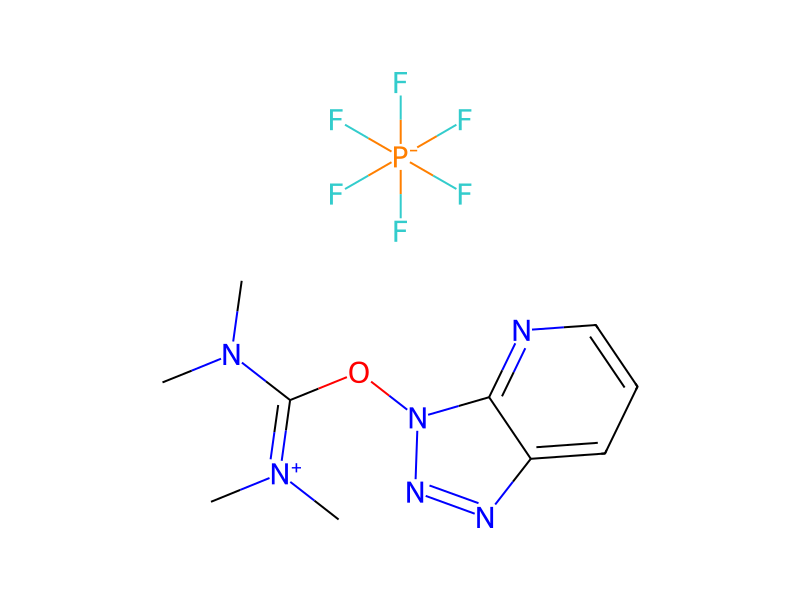 HCID 9886157Methanaminium, N-((dimethylamino)(3H-1,2,3-triazolo(4,5-b)pyridin-3-yloxy)methylene)-N-methyl-, hexafluorophosphate(1-) (1:1)
 HCID 10942966(2S)-2-((methoxycarbonyl)amino)-3-methylbutanoic acid
 HCID 58315880HCID 58315880, compound
Product 2

Reagents, catalysts & solvents 2


Procedure
HATU (40 mg, 0.11 mmol) was added to a mixture of a TFA salt of 2-((S)-pyrrolidin-2-yl)-6-(6-(2-((S)-pyrrolidin-2-yl)-1H-imidazol-5-yl)naphthalen-2-yl)-1H-benzo[d]imidazole (32 mg), diisopropylethylamine (62 μL, 0.35 mmol) and (S)-2-(methoxycarbonylamino)-3-methylbutanoic acid (19 mg, 0.106 mmol) in DMF (2 mL) and the resulting mixture was stirred at ambient conditions for 9 hours. The reaction mixture was diluted with methanol (2 mL) and water (2 mL). The volatile component was removed in vacuo and the residue was purified by reverse phase HPLC (once with water/acetonitrile 10 mM ammonium acetate and twice with water/acetonitrile 0.1% TFA) to provide a TFA salt of methyl((1S)-1-(((2S)-2-(4-(6-(2-((2S)-1-((2S)-2-((methoxycarbonyl)amino)-3-methylbutanoyl)-2-pyrrolidinyl)-1H-benzimidazol-5-yl)-2-naphthyl)-1H-imidazol-2-yl)-1-pyrrolidinyl)carbonyl)-2-methylpropyl)carbamate (21 mg) as white solid. LC-MS retention time 1.17 min; Calcd. for C42H50N8O6 762.39 Found m/z 763.34 [M+H]+. LC data was recorded on a Shimadzu LC-10AS liquid chromatograph equipped with a Waters Sunfire 5u C18 4.6×50 mm column using a SPD-10AV UV-Vis detector at a detector wave length of 220 nM. The elution conditions employed a flow rate of 4 mL/min, a gradient of 100% Solvent A/0% Solvent B to 0% Solvent A/100% Solvent B, a gradient time of 3 min, a hold time of 1 min and an analysis time of 4 min where Solvent A was 10% acetonitrile/90% water/0.1% TFA and Solvent B was 90% acetonitrile/10% water/0.1% TFA. 1H NMR (500 MHz, MeOD) δ ppm 8.30 (s, 1H), 8.27 (s, 1H), 8.15 (d, J=8.9 Hz, 1H), 8.10 (d, J=8.9 Hz, 1H), 8.07 (s, 1H), 7.94-8.01 (m, 3H), 7.82-7.89 (m, 2H), 5.38 (t, J=7.2 Hz, 1H), 5.31 (t, J=7.6 Hz, 1H), 4.28 (dd, J=14.5, 7.2 Hz, 2H), 4.15 (br s, 2H), 3.86-4.01 (m, 2H), 3.69 (s, 6H), 2.55-2.69 (m, 2H), 2.19-2.39 (m, 6H), 2.04-2.15 (m, 2H), 0.86-1.05 (m, 12H).
Workup
- customThe volatile component was removed in vacuo
- customthe residue was purified by reverse phase HPLC (once with water/acetonitrile 10 mM ammonium acetate
Sources & evidence
- ORD record
- ord-8edde340aee845f695f0016a7e1bcd44
- Source dataset
- uspto-grants-2015_04
- Patent number
- US09006455B2
Reaction notes
Loading…