Dimethylformamide → HCID 89692899, compound
Reaction equation

[NH2:1][C:2]1[C:3]([N:21]2[CH2:26][CH2:25][N:24]([C:27]3[CH:32]=[C:31]([F:33])[CH:30]=[CH:29][C:28]=3[CH3:34])[CH2:23][CH2:22]2)=[CH:4][C:5]([Cl:20])=[C:6]([CH:19]=1)[C:7]([NH:9][CH2:10][CH2:11][CH2:12][N:13]1[CH2:17][CH2:16][CH2:15][C:14]1=[O:18])=[O:8].CN(C)C=O.CN(C(ON1N=NC2C=CC=NC1=2)=[N+](C)C)C.F[P-](F)(F)(F)(F)F.C(N(CC)C(C)C)(C)C.[CH:73]1([C:76]2[O:77][CH:78]=[C:79]([C:81](O)=[O:82])[N:80]=2)[CH2:75][CH2:74]1>O.C(OCC)(=O)C>[Cl:20][C:5]1[C:6]([C:7](=[O:8])[NH:9][CH2:10][CH2:11][CH2:12][N:13]2[CH2:17][CH2:16][CH2:15][C:14]2=[O:18])=[CH:19][C:2]([NH:1][C:81]([C:79]2[N:80]=[C:76]([CH:73]3[CH2:75][CH2:74]3)[O:77][CH:78]=2)=[O:82])=[C:3]([N:21]2[CH2:22][CH2:23][N:24]([C:27]3[CH:32]=[C:31]([F:33])[CH:30]=[CH:29][C:28]=3[CH3:34])[CH2:25][CH2:26]2)[CH:4]=1Participants
Reactant 5




Product 1

Reagents, catalysts & solvents 2


Procedure
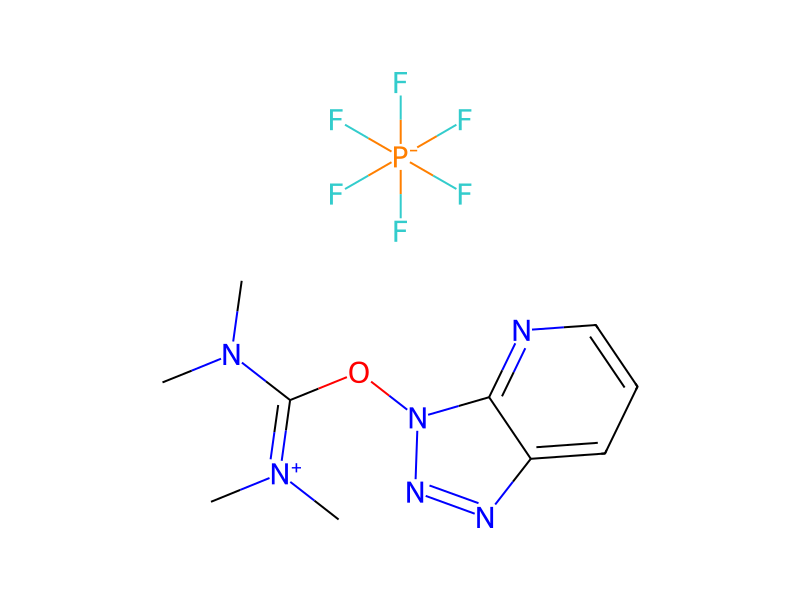
In a 40 ml scintillation vial equipped with a magnetic stir bar and a fitted with a nitrogen inlet, the 5-amino-2-chloro-4-[4-(5-fluoro-2-methyl-phenyl)-piperazin-1-yl]-N-[3-(2-oxo-pyrrolidin-1-yl)-propyl]-benzamide 16g (130 mg, 0.27 mmol) was taken up in clean, dry N,N-dimethylformamide (3.00 ml, 38.74 mmol) and the mixture was allowed to stir under nitrogen at room temperature until all solids were in solution. To this mixture was added the HATU (121.60 mg, 0.32 mmol) followed by the N,N-diisopropylethylamine (0.14 ml, 0.80 mmol) and the mixture was allowed to stir until all solids were taken into solution. The 2-cyclopropyl-oxazole-4-carboxylic acid 1h (56.80 mg, 0.37 mmol) was added to the reaction mixture and the reaction stirred at room temperature overnight. The reaction was diluted with 10 ml of water and 10 ml of ethyl acetate. The layers were separated and the product was extracted from the aqueous using ethyl acetate (3×15 ml). The organic phases were combined, washed with brine (1×25 ml) and with saturated aqueous lithium chloride solution (2×25 ml). The solution was then dried over Na2SO4; the solution was then decanted and the solvent was removed under reduced pressure. The product was purified from the resultant brown semi-solid using silica gel column chromatography, eluting a gradient of 100% dichloromethane to 10% MeOH in dichloromethane. A secondary purification was required and the compound was purified using reverse-phase prep HPLC, eluting a gradient of 30% MeOH in water to 100% MeOH over a 5 min period. The product, 2-cyclopropyl-oxazole-4-carboxylic acid {4-chloro-2-[4-(5-fluoro-2-methyl-phenyl)-piperazin-1-yl]-5-[3-(2-oxo-pyrrolidin-1-yl)-propylcarbamoyl]-phenyl}-amide 16h (11.20 mg, 0.02 mmol), was isolated as a white solid.
Workup
- customIn a 40 ml scintillation vial equipped with a magnetic stir bar
- customa fitted with a nitrogen inlet
- stirringto stir until all solids
- stirringthe reaction stirred at room temperature overnight
- customThe layers were separated
- extractionthe product was extracted from the
- washwashed with brine (1×25 ml) and with saturated aqueous lithium chloride solution (2×25 ml)
- dry with materialThe solution was then dried over Na2SO4
- customthe solution was then decanted
- customthe solvent was removed under reduced pressure
- customThe product was purified from the resultant brown semi-solid
- washeluting a gradient of 100% dichloromethane to 10% MeOH in dichloromethane
- customA secondary purification
- customthe compound was purified
- washeluting a gradient of 30% MeOH in water to 100% MeOH over a 5 min period
Sources & evidence
- ORD record
- ord-c517a5f3593f4470ab90658837d7bd50
- Source dataset
- uspto-grants-2016_08
- Patent number
- US09409897B2
Reaction notes
Loading…