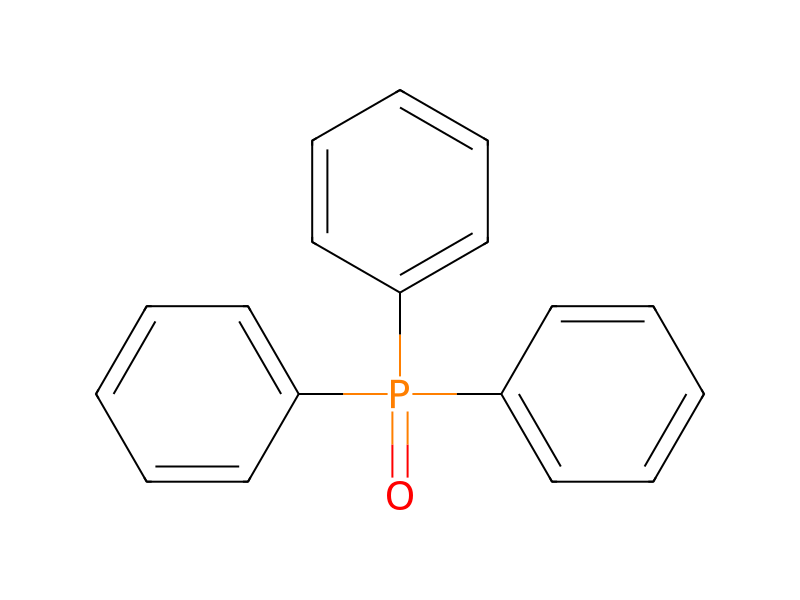
Toluene → Triphenylphosphine Oxide
Reaction equation

CC1C=CC([N+]([O-])=[O:9])=CC=1O.CN(C)CCO.[C:18]1([P:24]([C:31]2[CH:36]=[CH:35][CH:34]=[CH:33][CH:32]=2)[C:25]2[CH:30]=[CH:29][CH:28]=[CH:27][CH:26]=2)[CH:23]=[CH:22][CH:21]=[CH:20][CH:19]=1.CCOC(/N=N/C(OCC)=O)=O.C1(C)C=CC=CC=1>C1COCC1>[C:31]1([P:24](=[O:9])([C:18]2[CH:19]=[CH:20][CH:21]=[CH:22][CH:23]=2)[C:25]2[CH:30]=[CH:29][CH:28]=[CH:27][CH:26]=2)[CH:32]=[CH:33][CH:34]=[CH:35][CH:36]=1Participants






Procedure
As another non-limiting example, 2-methyl-5-nitrophenol (2.00 g, 13.07 mmol), N,N-dimethylethanolamine (1.31 mL, 13.07 mmol) and triphenylphosphine (4.46 g, 16.99 mmol) were placed in a 100 mL round-bottomed flask under nitrogen. 40 mL of anhydrous THF were added via syringe at 0° C. After stirring the reaction mixture at this temperature for 10 minutes, 7.32 mL of a solution of diethylazodicarboxylate 40% in toluene (2.93 g, 16.99 mmol) were added via syringe. The reaction was warmed to room temperature and stirred under nitrogen for two hours. The solvents were removed under vacuum. Triphenylphosphine oxide formed during the reaction was precipitated in a mixture of ethyl acetate/hexane and filtrated. The crude was then purified by flash chromatography (0 to 2% of MeOH in DCM) to afford 10 (2.11 g, 70%) as a yellow oil.
Workup
- stirringstirred under nitrogen for two hours
- customThe solvents were removed under vacuum
Sources & evidence
- ORD record
- ord-979eb49c8ed64bca9e686a371bce323a
- Source dataset
- uspto-grants-2016_08
- Patent number
- US09421211B2
Reaction notes
Loading…