Ethyl Acetate → 2,4-Dichloroaniline
Reaction equation

[Cl:1][C:2]1[C:7]([N+:8]([O-])=O)=[CH:6][CH:5]=[C:4]([Cl:11])N=1.[CH3:12]C(=O)OCC>C(O)(=O)C.[Fe]>[Cl:1][C:2]1[CH:12]=[C:4]([Cl:11])[CH:5]=[CH:6][C:7]=1[NH2:8]Participants
5
Reactant 2

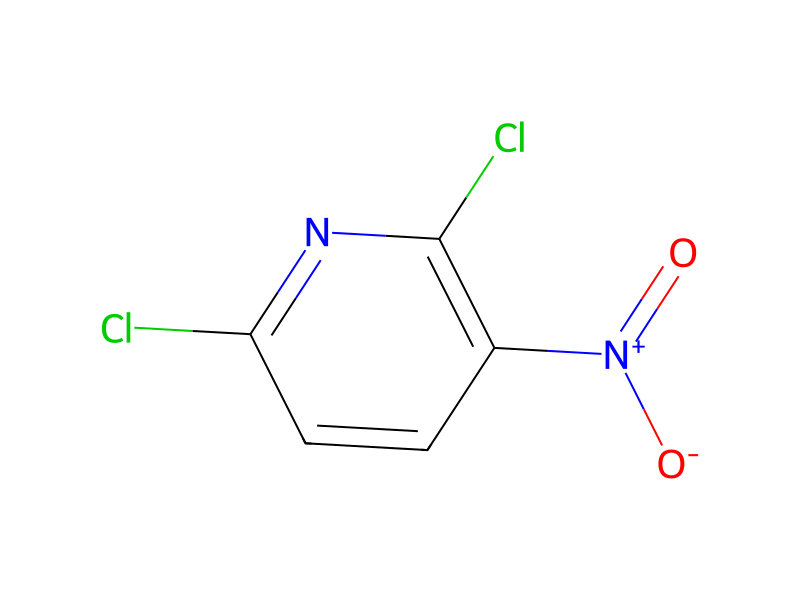
Product 1

Reagents, catalysts & solvents 2


Procedure
To a solution of 2,6-dichloro-3-nitropyridine (100 g, 0.518 mol) in acetic acid (1 L) was added iron powder (86.49 g, 1.555 mol) portion wise. The resulting reaction mixture was stirred at room temperature for 6 h. The completion of the reaction was confirmed by checking TLC system (PE/EA=8:2). The reaction mass was concentrated under high vacuum. The crude was dissolved in water (1 L) and EtOAc (2 L). While stirring, the pH of the aqueous solution was adjusted to 6.5 using powder Na2CO3. The mixture was filtered through CELITE® and the organic layer was separated, dried and concentrated to give 2,4-dichloroaniline (80 g, 95%) as a white solid. 1H NMR (400 MHz, DMSO-d6) δ ppm 7.14-7.2 (2H, m); 5.78 (2H, s).
Workup
- customThe resulting reaction mixture
- concentrationThe reaction mass was concentrated under high vacuum
- dissolutionThe crude was dissolved in water (1 L)
- stirringWhile stirring
- filtrationThe mixture was filtered through CELITE®
- customthe organic layer was separated
- customdried
- concentrationconcentrated
Sources & evidence
- ORD record
- ord-ff347d8caf414597ad249884ca58ec58
- Source dataset
- uspto-grants-2016_08
- Patent number
- US09428504B2
Reaction notes
Loading…