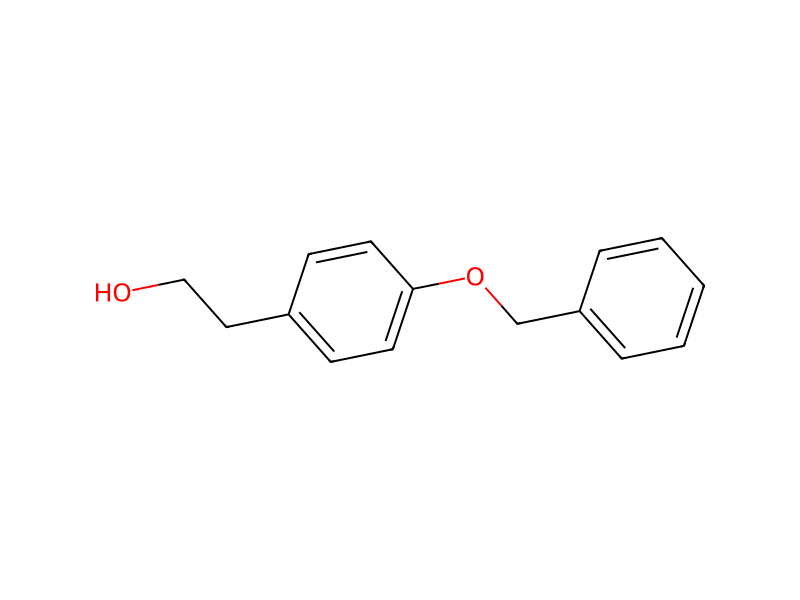
Diethyl Ether → p-(Benzyloxy)phenethyl alcohol
Reaction equation

[OH:1][C:2]1[CH:10]=[CH:9][C:5]([CH2:6][CH2:7][OH:8])=[CH:4][CH:3]=1.[CH2:11](Br)[C:12]1[CH:17]=[CH:16][CH:15]=[CH:14][CH:13]=1.C(=O)([O-])[O-].[K+].[K+].CCOCC>CC(C)=O.O>[CH2:11]([O:1][C:2]1[CH:10]=[CH:9][C:5]([CH2:6][CH2:7][OH:8])=[CH:4][CH:3]=1)[C:12]1[CH:17]=[CH:16][CH:15]=[CH:14][CH:13]=1Participants
7
Reactant 4




Product 1
Reagents, catalysts & solvents 2


Procedure
A mixture of 4-hydroxyphenethyl alcohol (15.02 g), benzyl bromide (13.6 ml), and potassium carbonate (75.1 g) in acetone (250 ml) is heated at reflux for about 4 hours. The mixture is cooled and poured into ether and water. The organic layer is washed with water, 1N sodium hydroxide solution, brine, dried over magnesium sulfate, filtered and concentrated in vacuo to give 4-benzyloxyphenethyl alcohol.
Workup
- temperatureis heated
- temperatureat reflux for about 4 hours
- temperatureThe mixture is cooled
- washThe organic layer is washed with water, 1N sodium hydroxide solution, brine
- dry with materialdried over magnesium sulfate
- filtrationfiltered
- concentrationconcentrated in vacuo
Sources & evidence
- ORD record
- ord-b2691b85c0e342e2a1caeac5db949915
- Source dataset
- uspto-grants-1997_10
- Patent number
- US05674482
Reaction notes
Loading…