Biphenyl → (4-Methoxyphenyl)boronic acid
Reaction equation

C1(C2C=CC=CC=2)C=CC=CC=1.Br[C:14]1[CH:19]=[CH:18][C:17]([O:20][CH3:21])=[CH:16][CH:15]=1.[B:22](OC)([O:25]C)[O:23]C>C1COCC1.OS(O)(=O)=O>[CH3:21][O:20][C:17]1[CH:18]=[CH:19][C:14]([B:22]([OH:25])[OH:23])=[CH:15][CH:16]=1Participants
Reactant 3

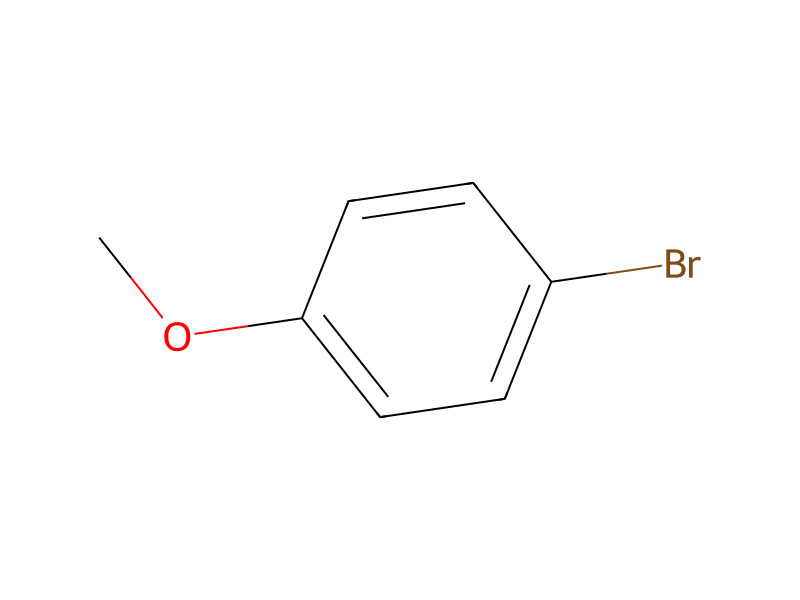

Product 1
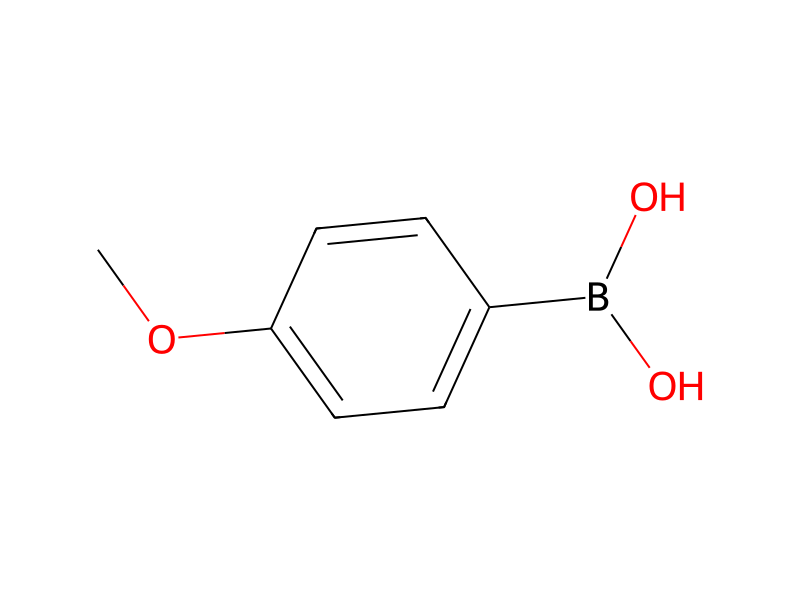
Reagents, catalysts & solvents 2


Procedure
Intermediate 9H-Carbazole-9-akylamines 3 and 4 (Scheme 1). Both starting biphenyl derivatives 1a and 1b were synthesized by Suzuki coupling methodology [Martin, et al, Acta Chem. Scand. 47, 221-230 (1993); and Miyaura, et al, Syn. Commun., 11, 513 (1981)]. A Grignard reagent was prepared from 4-bromoanisole which was subsequently reacted with trimethyl borate in THF. Hydrolysis of the product in aqueous H2SO4 gave 4-methoxyphenylboronic acid. This was then coupled to 1-bromo-2-nitrobenzene or 4-bromo-3-nitroanisole in a mixture of (Ph3P)4Pd, aqueous Na2CO3, EtOH, and benzene to give 1a or 1b, respectively. The biphenyls 1a and 1b were subsequently refluxed in triethyl phosphite to give the carbazoles 2a and 2b. These were then alkylated with bromoacetonitrile in NaH/DMF to afford the respective carbazole-9-acetonitriles. The reduction of the nitriles was accomplished with Raney nickel and aqueous ammonia in 2-methoxyethanol to give the 9H-carbazole-9-ethanamines 3a and 3b. The propanamine 4 was prepared by conjugate addition of 2b to acrylonitrile in NaH/DMF, followed by reduction of the resulting propionitrile with Raney nickel in Ac20 to yield the propyl acetamide. Subsequent hydrolysis in 20% NaOH and EtOH gave the 9H-carbazole-9-propanamine 4. ##STR7##
Workup
- customwere synthesized by Suzuki
Sources & evidence
- ORD record
- ord-c1347188d3924f34974eb3bf38b73d6d
- Source dataset
- uspto-grants-1997_10
- Patent number
- US05677328
Reaction notes
Loading…