Triphenylphosphine → HCID 89580782, compound
Reaction equation

[OH:1][CH:2]([C:4]1[CH:12]=[CH:11][C:7]([C:8]([O-:10])=[O:9])=[CH:6][CH:5]=1)[CH3:3].[C:13]1(P(C2C=CC=CC=2)C2C=CC=CC=2)C=CC=CC=1.[N:32]1[CH:37]=[CH:36][C:35](O)=[CH:34][CH:33]=1.CC(OC(/N=N/C(OC(C)C)=O)=O)C>O1CCCC1>[N:32]1[CH:37]=[CH:36][C:35]([O:1][CH:2]([C:4]2[CH:12]=[CH:11][C:7]([C:8]([O:10][CH3:13])=[O:9])=[CH:6][CH:5]=2)[CH3:3])=[CH:34][CH:33]=1Participants
6




Procedure
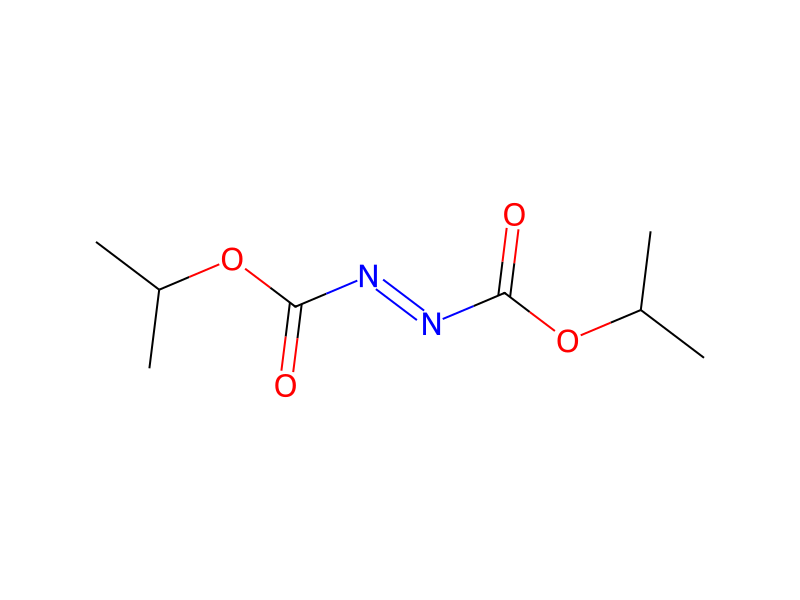
To a solution of 4-(1-hydroxyethyl)benzoate (300 mg. 1.67 mmol) in tetrahydrofuran (80 mL) were added triphenylphosphine (570 mg, 2.2 mmol) and pyridin-4-ol (159 mg, 1.67 mmol). The mixture was stirred for 30 minutes at room temperature, and then cooled to 0° C. And diisopropylazodicarboxylate (568.3 mg, 2.8 mmol) was added dropwise to the solution at 0° C. The resultant mixture was stirred at room temperature for 12 hours. Then the mixture was concentrated to give a residue and the residue was purified by column chromatography (silica gel, ethyl acetate/petroleum ether=1:10) to give methyl 4-(1-(pyridin-4-yloxy)ethyl)benzoate as an oil (151 mg, 35%). LRMS (M+H) m/z: calcd 257.1. found 257.
Workup
- temperaturecooled to 0° C
- concentrationThen the mixture was concentrated
- customto give a residue
- customthe residue was purified by column chromatography (silica gel, ethyl acetate/petroleum ether=1:10)
Sources & evidence
- ORD record
- ord-5bc8d46e7cc74eadb531428138d7d101
- Source dataset
- uspto-grants-2015_12
- Patent number
- US09206128B2
Reaction notes
Loading…