Hydrochloric Acid → 4-Vinylphenol
Reaction equation

C([O:4][C:5]1[CH:12]=[CH:11][C:8]([CH:9]=[CH2:10])=[CH:7][CH:6]=1)(=O)C.[OH-].[Na+].Cl>O1CCCC1>[CH:9]([C:8]1[CH:11]=[CH:12][C:5]([OH:4])=[CH:6][CH:7]=1)=[CH2:10]Participants
Reactant 3


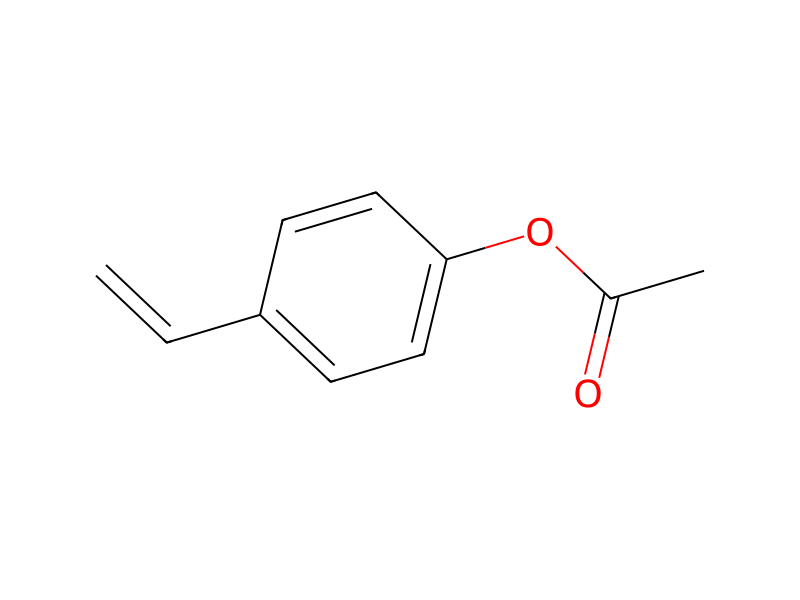
Product 1
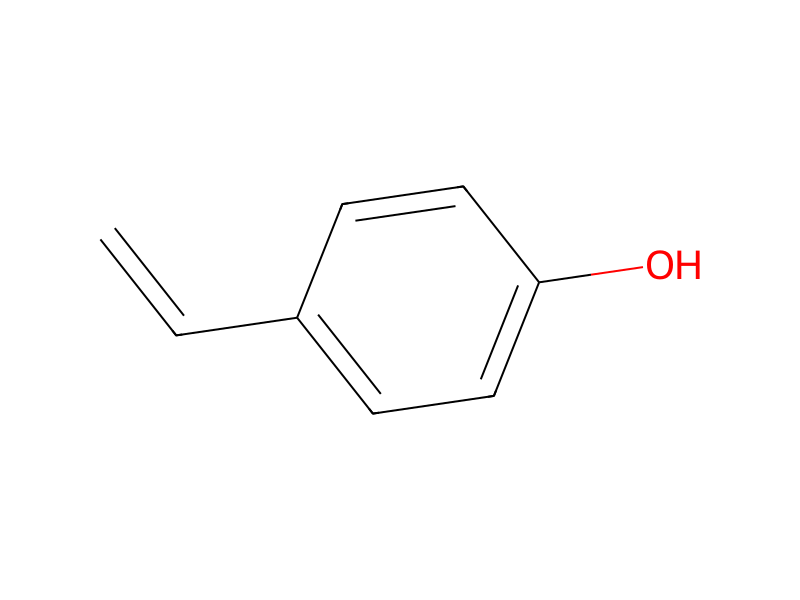
Reagents, catalysts & solvents 1

Procedure
Option 2: To a 250 ml round bottom flask under argon and fitted with a stir bar was added 4-acetoxystyrene (15.00 g, 92.6 mmol), tetrahydrofuran (0.97 M), and 5 M solution of sodium hydroxide (aq.) (93 ml), all of which were freshly sparged with argon. The reaction flask was sealed and the reaction was stirred at room temperature for one hour or until the reaction was complete as indicated by TLC (SiO2: Rf=0.7, 30% ethyl acetate/hexanes). The crude reaction mixture was chilled to 0° C., at which time 6 N HCl (aq.) (90 ml) was added slowly until a pH of neutral was reached. The product was extracted into ethyl acetate, washed with water three times, dried over MgSO4, filtered, and concentrated by rotary evaporation. Further drying under vacuum yielded 4-vinylphenol 21 (11.72 g, 99%) which was immediately used. A 100 ml schlenk flask under argon was charged with deoxygenated (via the freeze-pump-thaw method, 3 times) t-butanol (0.23 M), 4-vinylphenol 21 (0.50 g, 4.16 mmol), 6-bromohexanenitrile (0.81 g, 4.58 mmol), and potassium t-butoxide (0.56 g, 4.58 mmol). The reaction flask was heated to 97° C. at which time the reaction flask was sealed and the reaction stirred for 18 hours. The crude reaction mixture was then chilled to 0° C., at which time 6 N HCl (aq.) (0.1 ml) was added slowly until a pH of neutral was reached yielding compound 22. Or, with the addition of more acid, in situ-polymerization occurred yielding compound 19. The crude product was extracted into ethyl acetate and washed with water until reaching a pH of neutral. The organic layer was dried over MgSO4, filtered, and then concentrated by rotary evaporation and further dried under vacuum to yield compound 19 (0.61 g, 68%) which was used without further purification. 1H NMR (300 MHz, CDCl3): δ 6.65 (br, 4H), 3.87 (br, 2H), 2.35 (br, 2H), 1.69 (br, 7H), 1.25 (br, 2H). 13C NMR (60 MHz, acetone-d6): δ 157.71, 138.00, 129.08, 120.49, 114.62, 67.88, 41.29, 41.28, 29.15, 25.88, 25.79, 17.
Workup
- customOption 2: To a 250 ml round bottom flask under argon and fitted with a stir bar
- customall of which were freshly sparged with argon
- customThe reaction flask was sealed
- customThe crude reaction mixture
- additionwas added slowly until a pH
- extractionThe product was extracted into ethyl acetate
- washwashed with water three times
- dry with materialdried over MgSO4
- filtrationfiltered
- concentrationconcentrated by rotary evaporation
- customFurther drying under vacuum
Sources & evidence
- ORD record
- ord-58aa103b7b0049808e6461ef92c60a29
- Source dataset
- uspto-grants-2015_12
- Patent number
- US09217062B2
Reaction notes
Loading…