Ethanol → HCID 57738060, compound
Reaction equation

[F:1][C:2]1[CH:3]=[N:4][CH:5]=[C:6](B2OC(C)(C)C(C)(C)O2)[CH:7]=1.Br[C:18]1[CH:23]=[C:22]([C:24]2[N:29]=[CH:28][CH:27]=[CH:26][N:25]=2)[C:21]([NH2:30])=[C:20]([N+:31]([O-:33])=[O:32])[CH:19]=1.[O-]P([O-])([O-])=O.[K+].[K+].[K+].CCO>[Br-].C([N+](C)(C)C)CCCCCCCCCCCCCCC.CC([O-])=O.CC([O-])=O.[Pd+2].C1C=CC(P(C2C=CC=CC=2)C2C=CC=CC=2)=CC=1.O>[F:1][C:2]1[CH:7]=[C:6]([C:18]2[CH:23]=[C:22]([C:24]3[N:29]=[CH:28][CH:27]=[CH:26][N:25]=3)[C:21]([NH2:30])=[C:20]([N+:31]([O-:33])=[O:32])[CH:19]=2)[CH:5]=[N:4][CH:3]=1Participants
Reactant 4




Product 1

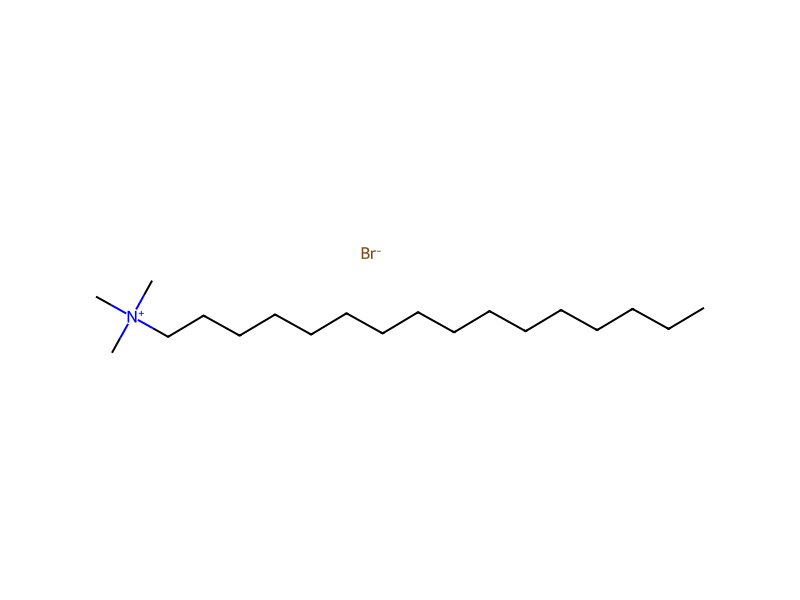
Reagents, catalysts & solvents 4



Conditions
- Temperature
- 80 °C
Procedure
A 3 L round-bottom flask was fitted with a mechanical overhead stirrer, a reflux condenser, and a thermometer and purged with N2. 3-Fluoro-5-(4,4,5,5-tetramethyl-1,3,2-dioxaborolan-2-yl)pyridine (2) (95.0 g, 421 mmol, 1.2 equiv), 4-bromo-2-nitro-6-(pyrimidin-2-yl)benzenamine (3) (104.55 g, 354 mmol, 1.0 equiv), K3PO4 (93.1 g, 438 mmol, 1.25 equiv, Riedel-deHaen #S29375-366), Pd(OAc)2 (0.80 g, 3.5 mmol, 1 mol %, Aldrich #06410JE) cetyltrimethylammonium bromide (1.28 g, 3.5 mmol, 1 mol %, Aldrich #0823CE) and PPh3 (3.74 g, 14 mmol, 4 mol %, Fluka #1093859) were added followed by EtOH (10 vols) and water (1.1 vols). The heterogeneous reaction mixture was stirred vigorously (>300 rpm) and heated to reflux (80° C.). After 6 hours a sample was removed for analysis of reaction completion (method C). After the reaction was judged complete, the mixture was cooled to 30° C., then water (10 vol) was added and the reaction stirred for 2 h. The resulting slurry was filtered and the filter cake washed with water (2×5 vol) and acetonitrile (2×5 vol). The filter cake was then charged back to the flask and water added (10 vol). The slurry was stirred for 3 h at 30° C. and filtered again. The filter cake was then transferred to a dish and allowed to dry under vacuum at 60-80° C. for 12 h furnishing compound (4) as an orange powder (104.87 g, 88%, purity: 96.14% AUC determined using method A). Typical reaction times were 7.9 min for SM (2) and 6.9 min for product (4).
Workup
- customA 3 L round-bottom flask was fitted with a mechanical overhead stirrer, a reflux condenser
- customa thermometer and purged with N2
- temperatureheated
- customAfter 6 hours a sample was removed for analysis of reaction completion (method C)
- temperaturethe mixture was cooled to 30° C.
- additionwater (10 vol) was added
- stirringthe reaction stirred for 2 h
- filtrationThe resulting slurry was filtered
- washthe filter cake washed with water (2×5 vol) and acetonitrile (2×5 vol)
- additionThe filter cake was then charged back to the flask and water
- additionadded (10 vol)
- stirringThe slurry was stirred for 3 h at 30° C.
- filtrationfiltered again
- customto dry under vacuum at 60-80° C. for 12 h
Sources & evidence
- ORD record
- ord-109e827067b9457b899633bacb5a5fd9
- Source dataset
- uspto-grants-2012_07
- Patent number
- US08217172B2
Reaction notes
Loading…