4-Bromophenol → 4-Bromophenyl-(3,4-dichlorobenzyl)ether
Reaction equation

[Br:1][C:2]1[CH:7]=[CH:6][C:5]([OH:8])=[CH:4][CH:3]=1.[Cl:9][C:10]1[CH:11]=[C:12]([CH:15]=[CH:16][C:17]=1[Cl:18])[CH2:13]O.C1(P(C2C=CC=CC=2)C2C=CC=CC=2)C=CC=CC=1.C1(C)C=CC=CC=1.N(C(OCC)=O)=NC(OCC)=O>O1CCCC1>[Br:1][C:2]1[CH:7]=[CH:6][C:5]([O:8][CH2:13][C:12]2[CH:15]=[CH:16][C:17]([Cl:18])=[C:10]([Cl:9])[CH:11]=2)=[CH:4][CH:3]=1Participants
6





Procedure
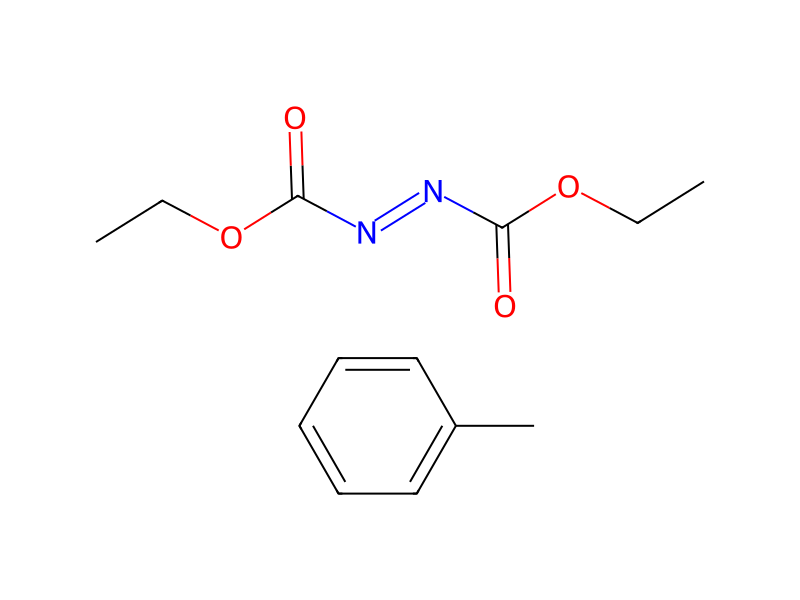
4-Bromophenol (1.07 g, 6.18 mmol), 3,4-dichlorobenzyl alcohol (1.42 g, 8.02 mmol), and triphenylphosphine (2.10 g, 8.01 mmol) were dissolved in tetrahydrofuran (30 mL), and a diethyl azodicarboxylate toluene solution (2.2M, 3.65 mL, 8.03 mmol) was slowly added dropwise thereto at room temperature, and then, the resulting mixture was stirred under a nitrogen atmosphere at room temperature for 2 hours. The solvent was distilled off under reduced pressure, and the resulting residue was purified by silica gel column chromatography (hexane:ethyl acetate=100:0 to 95:5 (v/v)), whereby the objective title compound was obtained as a white solid (2.25 g, quantitative).
Workup
- distillationThe solvent was distilled off under reduced pressure
- customthe resulting residue was purified by silica gel column chromatography (hexane:ethyl acetate=100:0 to 95:5 (v/v)), whereby the objective title compound
- customwas obtained as a white solid (2.25 g, quantitative)
Sources & evidence
- ORD record
- ord-eec749a1bfb745a4ad7131ef11fc9d71
- Source dataset
- uspto-grants-2012_07
- Patent number
- US08222281B2
Reaction notes
Loading…