4-Pyridinecarbaldehyde oxime → HCID 178526344, compound
Reaction equation

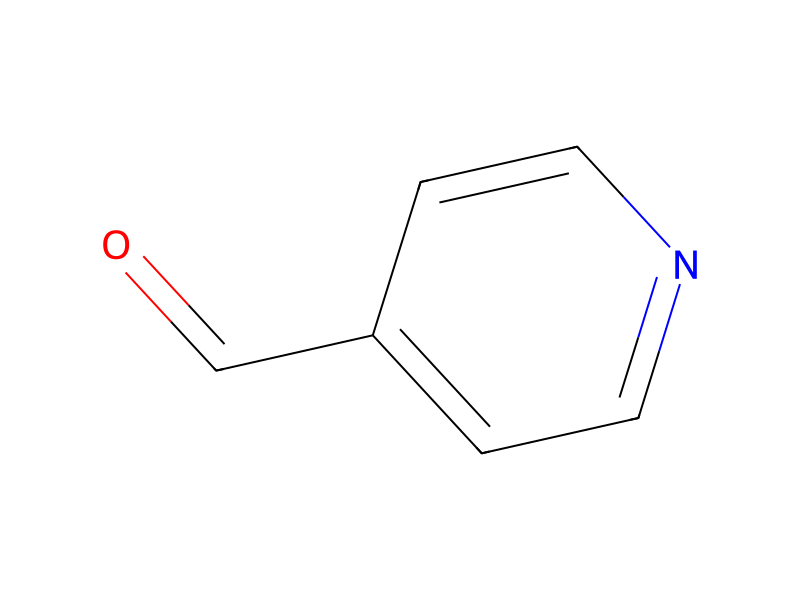
Cl.NO.N1C=CC(C=[O:11])=CC=1.[N:12]1[CH:17]=[CH:16][C:15]([CH:18]=[N:19][OH:20])=[CH:14][CH:13]=1.C(=O)([O-])O.[Na+].P([O-])([O-])([O-])=O.[K+].[K+].[K+]>O>[OH:11][C:13]1[CH:14]=[C:15]([CH:18]=[N:19][OH:20])[CH:16]=[CH:17][N:12]=1Participants






Conditions
- Temperature
- 65 °C
Procedure
1.3 g of hydroxylamine hydrochloride was solved to 5 g of ion-exchange water, and the solution was heated to 65° C. Then 2 g of 4-pyridinecarbaldehyde was added dropwise. The reaction was carried out at 65° C., for 30 minutes, and a solution containing 2.2 g of 4-pyridinaldoxime was obtained. The resulting 4-pyridinaldoxime was identified by HPLC analysis. Thereafter, the reaction solution was cooled to 30° C., and was neutralized by saturated sodium hydrogen carbonate solution to be adjusted to pH 6. Six hundred mL of 0.1M potassium phosphate buffer (adjusted to pH 7.0) was added to the neutralized solution. Further, as in Example 1, the Delftia species YGK-A649 (FERM BP-10389) was cultured, and thus, the bacterial cells in 1000 mL of the culture was collected by centrifugation to obtain the resting bacterial cells and then form a suspension thereof. The suspension was charged to a reaction vessel (2000 mL volume) capable of shaking, aerating, controlling temperature, and controlling pH, and a reaction was carried out at 20° C., and pH 7-8, while shaking and aerating. After the reaction for 108 hours, 2-hydroxy-4-pyridinaldoxime was obtained at yield rate of 87% in the reaction. The analysis values of the resulting 2-hydroxy-4-pyridinaldoxime by IR analysis, proton NMR analysis and MS analysis were the same as the values described in Example 3, and thus, the structure of the resulting 2-hydroxy-4-pyridinaldoxime was identified.
Workup
- customwas obtained
- temperatureThereafter, the reaction solution was cooled to 30° C.
- customthus, the bacterial cells in 1000 mL of the culture was collected by centrifugation
- customto obtain the resting bacterial cells
- customform a suspension
- additionThe suspension was charged to a reaction vessel (2000 mL volume) capable
- customwas carried out at 20° C.
- stirringpH 7-8, while shaking
- customAfter the reaction for 108 hours
Sources & evidence
- ORD record
- ord-f906465daea8408c81b46d242b9428f0
- Source dataset
- uspto-grants-2012_07
- Patent number
- US08227617B2
Reaction notes
Loading…