1-Bromo-3-chloropropane → Piperazine, 1-(3-chloropropyl)-4-(diphenylmethyl)-
Reaction equation

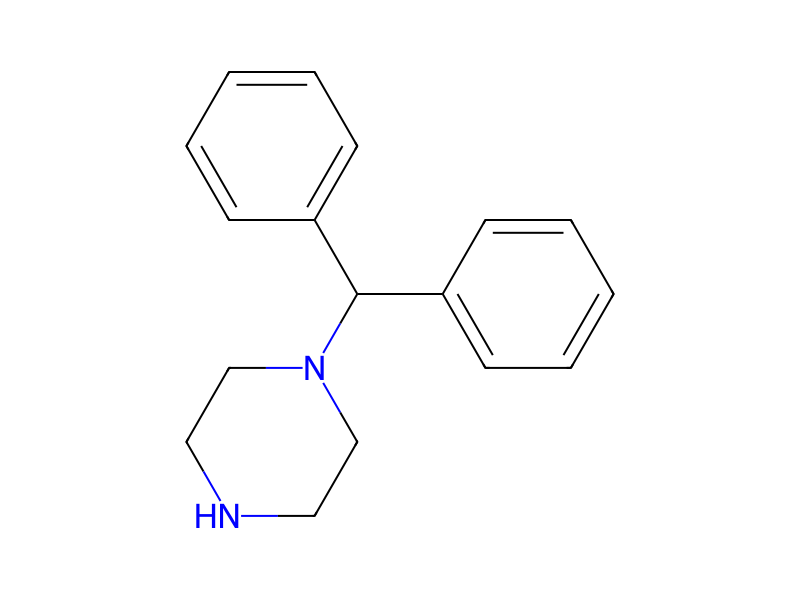
[C:1]1([CH:7]([C:14]2[CH:19]=[CH:18][CH:17]=[CH:16][CH:15]=2)[N:8]2[CH2:13][CH2:12][NH:11][CH2:10][CH2:9]2)[CH:6]=[CH:5][CH:4]=[CH:3][CH:2]=1.C(=O)([O-])[O-].[K+].[K+].Br[CH2:27][CH2:28][CH2:29][Cl:30]>CC(C)=O>[C:14]1([CH:7]([C:1]2[CH:2]=[CH:3][CH:4]=[CH:5][CH:6]=2)[N:8]2[CH2:9][CH2:10][N:11]([CH2:27][CH2:28][CH2:29][Cl:30])[CH2:12][CH2:13]2)[CH:19]=[CH:18][CH:17]=[CH:16][CH:15]=1Participants
5
Reactant 3


Product 1

Reagents, catalysts & solvents 1

Procedure
In acetone, 1-(diphenylmethyl)piperazine (18.49 g) was dissolved, and potassium carbonate (1.0 eq.) and 1-bromo-3-chloropropane (2.0 eq.) were added thereto, and the obtained mixture was heated to reflux for 3 hours. The salt produced by the reaction was separated by filtration, and the filtrate was then concentrated in vacuo. The residue was purified by silica gel column chromatography (Wakogel C-200, 200 g) and eluted by a mixed solvent of 99 parts of chloroform and 1 part of methanol to obtain 1-[4-(diphenylmethyl)piperazinyl]-3-chloropropane (13.8 g).
Workup
- temperaturethe obtained mixture was heated
- temperatureto reflux for 3 hours
- customThe salt produced by the reaction
- customwas separated by filtration
- concentrationthe filtrate was then concentrated in vacuo
- customThe residue was purified by silica gel column chromatography (Wakogel C-200, 200 g)
- washeluted by a mixed solvent of 99 parts of chloroform and 1 part of methanol
Sources & evidence
- ORD record
- ord-17e946a76465416597d607addfab7fb4
- Source dataset
- uspto-grants-2015_07
- Patent number
- US09073861B2
Reaction notes
Loading…