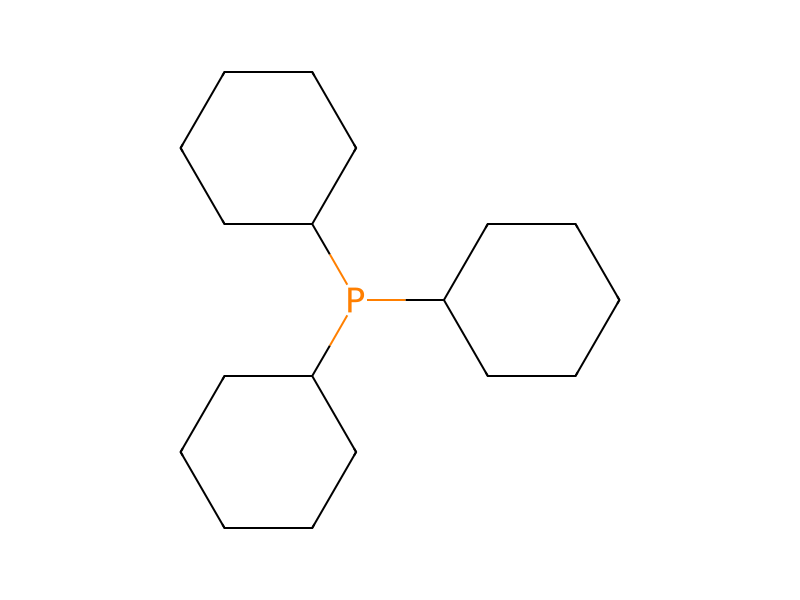
Tricyclohexylphosphine → HCID 70976931, compound
Reaction equation

Br[C:2]1[CH:3]=[C:4]([C:8]([CH3:14])([CH3:13])[C:9]([O:11][CH3:12])=[O:10])[CH:5]=[N:6][CH:7]=1.[B:15]1(B2OC(C)(C)C(C)(C)O2)[O:19]C(C)(C)C(C)(C)[O:16]1.C1(P(C2CCCCC2)C2CCCCC2)CCCCC1.C([O-])(=O)C.[K+]>C1C=CC(/C=C/C(/C=C/C2C=CC=CC=2)=O)=CC=1.C1C=CC(/C=C/C(/C=C/C2C=CC=CC=2)=O)=CC=1.C1C=CC(/C=C/C(/C=C/C2C=CC=CC=2)=O)=CC=1.[Pd].[Pd].O1CCOCC1>[CH3:12][O:11][C:9](=[O:10])[C:8]([C:4]1[CH:3]=[C:2]([B:15]([OH:19])[OH:16])[CH:7]=[N:6][CH:5]=1)([CH3:14])[CH3:13]Participants
7
Reactant 4


Product 1

Reagents, catalysts & solvents 2


Conditions
- Temperature
- 80 °C
Procedure
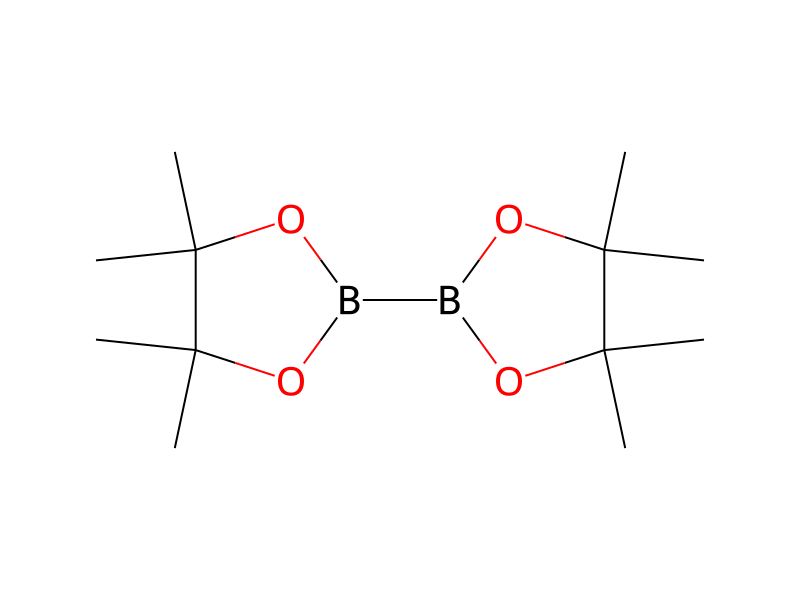
To a vial containing the title compound from Example 53 Step H (0.10 g, 0.39 mmol), bis(pinacolato)diboron (0.12 g, 0.47 mmol), tris(dibenzylideneacetone)dipalladium (0) (0.035 g, 0.039 mmol), tricyclohexylphosphine (0.022 g, 0.077 mmol) and potassium acetate (0.114 g, 1.16 mmol) was added 1,4-dioxane (3.9 mL). The reaction was heated to 80° C. for 16 hours. It was then cooled to room temperature, passed through a syringe filter, and concentrated under reduced pressure to afford the title compound: LCMS m/z 224.19 [M+H]+.
Workup
- temperatureIt was then cooled to room temperature
- custompassed through a syringe
- filtrationfilter
- concentrationconcentrated under reduced pressure
Sources & evidence
- ORD record
- ord-4f0b534500954174b7d3c0a8a485c60d
- Source dataset
- uspto-grants-2015_07
- Patent number
- US09073929B2
Reaction notes
Loading…