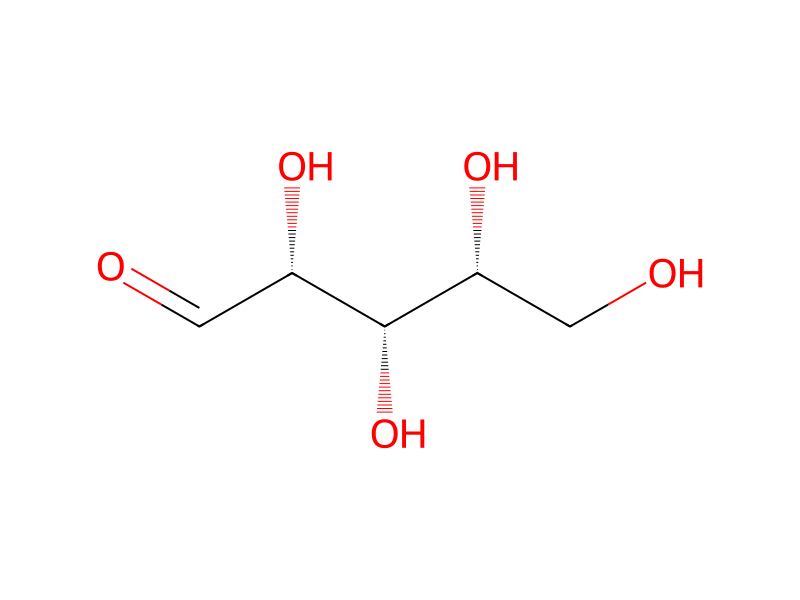
D-Arabinose → aldehydo-D-Xylose
Reaction equation

[O:1]=[CH:2][C@@H:3]([C@H:5]([C@@H:7]([C@@H:9](CO)[OH:10])[OH:8])[OH:6])[OH:4].O=C[C@H]([C@@H]([C@@H](CO)O)O)O.O=C[C@H]([C@H]([C@@H]([C@@H](CO)O)O)O)O>>[O:1]=[CH:2][C@@H:3]([C@H:5]([C@@H:7]([CH2:9][OH:10])[OH:8])[OH:6])[OH:4]Participants



Procedure
Recovery of carbohydrate and non-carbohydrate products from wheat straw was not greatly affected by scale of the reaction column (FIGS. 12(A), 12(B)). No differences were observed in the recovery of glucose or of the minor hemicellulose carbohydrates galactose, arabinose, and mannose for all column scales (FIG. 12(A)). The pilot-scale apparatus produced approximately 26 g more xylose per kilogram of dry straw than did the scale-up unit (FIG. 12(A)). However, the solid residues from both scales yielded equal amounts of residual xylan. The scale-up column came up to operating temperature much faster than the pilot-scale column, so the difference in xylose production was probably due to the creation of furfural from the higher temperature during the initial stages of hydrothermal treatment. The production of xylose from the bench-scale apparatus was 30 g/kg of dry straw less than the scale-up, and 56 g/kg of dry straw less than the pilot-scale apparatus, with an overall yield of 39% in the liquid fraction. The residual xylan in the solid residue was over three times greater than the other scale reaction columns, and 40% of the potential xylan remained. Hence, the difference was mostly due to incomplete hydrolysis due to insufficient residence time.
Sources & evidence
- ORD record
- ord-afdb96af5c5e42148af10ac861dd6683
- Source dataset
- uspto-grants-2015_07
- Patent number
- US09084948B2
Reaction notes
Loading…